Technical talent sourcing
The practice of identifying and engaging software engineers, data scientists, DevOps specialists, and other technical candidates through code repositories, developer communities, and skills-based signals rather than relying on traditional job-board inbounds.
Michal Juhas · Last reviewed May 4, 2026
What is technical talent sourcing?
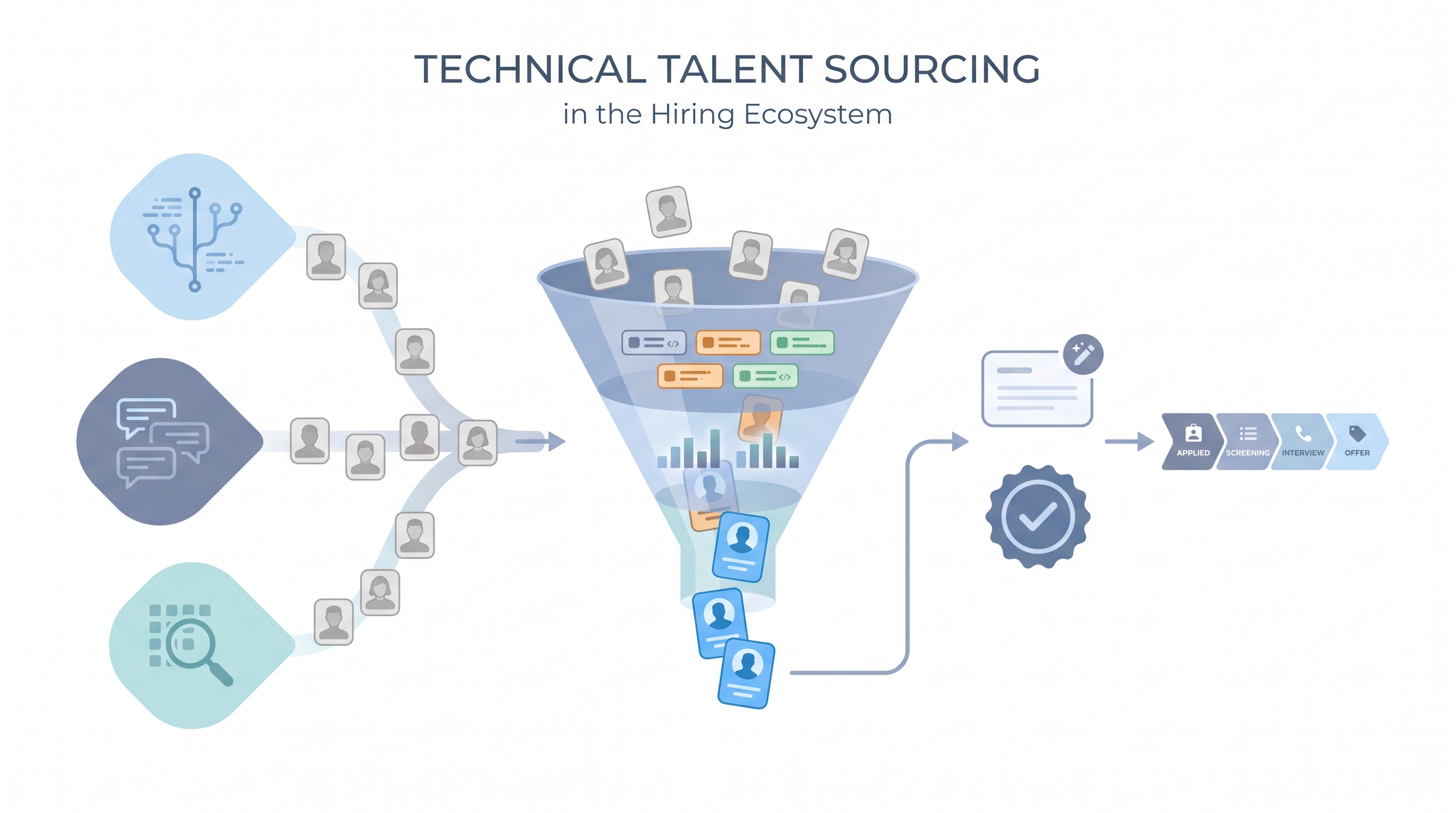
Technical talent sourcing is the practice of finding software engineers, data scientists, infrastructure specialists, and other technical professionals who are not actively applying to jobs. It differs from general sourcing because the strongest signal is often not a resume: it is what someone builds, contributes to, or writes about in developer communities.
A sourcer working a senior backend engineering role might spend the first hour reading GitHub repositories and commit histories before writing a single message. The goal is to understand what the candidate actually does at a code level, then craft outreach that shows you did the reading. Generic InMail referencing a job title lands in the same folder as every other unread message.
In practice
- A sourcer building a pipeline for a Rust engineering role X-rays GitHub profile bios for candidates listing Rust alongside related ecosystem tools, then cross-checks recent commit activity before prioritising the shortlist by signal quality.
- A full-cycle recruiter at a 200-person scale-up uses a boolean search string combining specific cloud certifications and city names to build a LinkedIn list, then layers GitHub enrichment to verify skills before outreach.
- A TA ops lead wires an AI model to read GitHub README files and draft personalised opening lines for each candidate, with a human-in-the-loop review step before any message goes out.
Quick read, then how hiring teams use it
This is for recruiters, sourcers, TA, and HR partners who hire technical roles or support teams that do. Skim the first section for a fast shared picture. Use the second when you are running an active search.
Plain-language summary
- What it means for you: Technical sourcing shifts the emphasis from job titles to skills signals. Instead of filtering by "Software Engineer," you look for evidence of the actual skills the role requires, then reach out before the candidate starts an active job search.
- How you would use it: Build a shortlist from GitHub or Stack Overflow X-ray results, verify recent activity, then personalise outreach to reference something specific in the candidate's public work. Personalised technical outreach consistently outperforms generic sequences on response rate.
- How to get started: Pick one open technical req. Write the three to five skills that would appear in the work the person actually does, not the job title. Build a boolean search string around those skills, run it on GitHub and LinkedIn, and compare the two shortlists.
- When it is a good time: Any time a technical req has been open more than two weeks without enough qualified responses from inbound. Also when entering a new tech stack or hiring for a role your team has not placed before.
When you are running live reqs and tools
- What it means for you: Technical sourcing at scale needs deduplication and channel tracking, not just intent. A CRM field for first touch channel and skills signal source is the minimum. Without it, two sourcers on the same req will contact the same candidate from different angles.
- How to use it: Connect your sourcing tool to your ATS so candidates are deduplicated before sequences launch. Enrich GitHub profiles through contact enrichment for sourcing before loading into outreach tools. Set suppression windows so a candidate who receives a message on one channel is excluded from parallel campaigns.
- How to get started: Run a 30-day pilot on one technical role. Agree on the skills signals that qualify a candidate before you start, not after reviewing the shortlist. Track channel and signal source at first touch so post-mortems have data to work from.
- When it is a good time: After you have one reliable sourcing channel that works for technical roles. Adding channels before you have a baseline means you cannot measure what moved the needle.
- What to watch for: GitHub API rate limits, GDPR consent requirements for enrichment data not provided directly by the candidate, and outreach sequences that reference public code without checking if the candidate is comfortable with public profiling. Calibrate message volume to stay below platform limits and above response-rate thresholds worth measuring.
Where we talk about this
On AI with Michal live sessions we build technical sourcing workflows in real time: the sourcing automation blocks walk through GitHub X-ray strings, boolean search on developer platforms, and contact enrichment pipelines end to end, while the AI in recruiting blocks show how to wire a model into the skills-reading and drafting step with a human review gate before send. If you want a live build with your actual reqs and tool questions in the room, start at Workshops and bring an open technical role.
Around the web (opinions and rabbit holes)
Third-party creators move fast. Treat these as starting points, not endorsements, and double-check anything before you wire candidate data across platforms.
YouTube
These open a results page; use Filters → Upload date when you want recent walkthroughs. Prefer sessions that show real profile reading (commits, issues, tags) before outreach, not only keyword hacks.
- GitHub sourcing + technical recruiting (reading bios, repos, and contribution signals before first message)
- Glen Cathey Boolean sourcing (deep Boolean patterns across LinkedIn, job boards, and the open web)
- Stack Overflow X-ray + developer sourcing (site: patterns and reputation signals for engineers who rarely update LinkedIn)
- Boolean search software engineers LinkedIn (title and keyword stacks for common stack families)
- SourceCon technical sourcing (conference-style talks; quality varies by year and speaker)
Long-form baseline on LinkedIn Boolean (not GitHub-specific, but the syntax carries): Become a LinkedIn Search Ninja: Advanced Boolean Search (Glen Cathey, Talent Connect London 2014).
Conference and industry uploads often land on ERE Media on YouTube (SourceCon / recruiting innovation style content mixed with other TA topics; use search within the channel once you are there).
- r/Sourcing is an active sourcing community; filter by top posts and search "technical sourcing" or "GitHub" for practitioner data on what signals and channels actually produce responses from engineers.
- r/recruiting surfaces agency and in-house perspectives on tech hiring; search "engineering sourcing" for threads on platform mix, response rates, and the tradeoffs between specialist sourcers and generalist full-cycle recruiters on technical roles.
Quora
- Quora search: technical talent sourcing returns practitioner and HR consultant answers on sourcing software engineers; read credentials before following tool recommendations, as vendor relationships vary.
Technical sourcing versus general sourcing
| Dimension | General sourcing | Technical sourcing |
|---|---|---|
| Primary signal | Job title and location | Skills evidence in code and community |
| Best channels | LinkedIn, job boards | GitHub, Stack Overflow, developer communities |
| Outreach personalisation | Company and role | Specific project, tech stack, or contribution |
| Evaluation before first message | Resume scan | Code review, commit history, tech community presence |
| GDPR considerations | Standard | Developer platform enrichment adds subprocessor obligations |