Outbound talent sourcing
Proactively identifying and contacting candidates who have not applied, using LinkedIn, Boolean search, data enrichment, and AI tools to build a targeted pipeline ahead of or during live requisitions.
Michal Juhas · Last reviewed May 4, 2026
What is outbound talent sourcing?
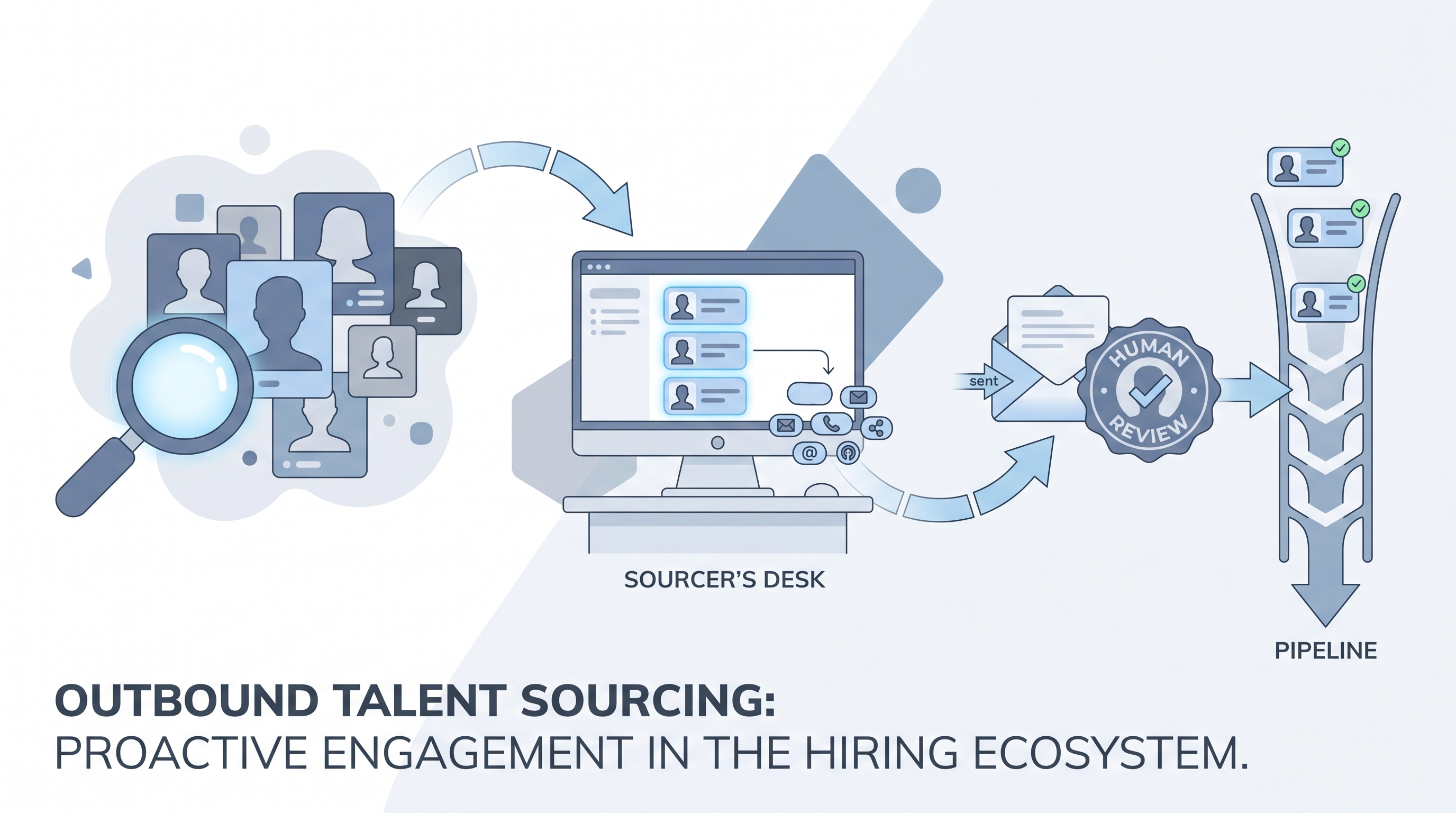
Outbound talent sourcing is the practice of proactively identifying and reaching out to candidates who have not applied to your role. Instead of waiting for applications, you build a list of target profiles using LinkedIn, Boolean search, GitHub, data enrichment tools, or a proprietary talent pool and send the first message.
The sourcing community sometimes draws the line between "outbound" (you initiate) and "inbound" (they apply), but in practice most teams run both in parallel: job ads attract the active market while sourcers work a curated short-list of passive candidates the ads will never reach.
In practice
- A sourcer building a list of senior engineers from company alumni pages, GitHub contribution graphs, and a LinkedIn Boolean string before the req is even open is doing outbound sourcing. The hiring manager calls it "finding people before we post."
- When a TA team sends a personalized InMail referencing a candidate's open-source project and follows up three days later with a second touch, that sequence is what outbound talent sourcing means in a Monday debrief.
- Recruiters at scale-ups sometimes call it "proactive sourcing" to distinguish it from waiting on the job board; agencies call it "headhunting" when the target is employed and not looking.
Quick read, then how hiring teams use it
This is for recruiters, sourcers, TA, and HR partners who need the same vocabulary in debriefs, vendor calls, and policy reviews. Skim the first section when you need a fast shared picture. Use the second when you are deciding how it shows up in your ATS, sourcing tools, or candidate communications.
Plain-language summary
- What it means for you: Instead of waiting for people to apply, you go find them, reach out first, and invite them to a conversation about the role.
- How you would use it: Pick a req, describe the ideal profile in two sentences, build a 50-100 name list from LinkedIn or data tools, and send a short personalized note to each.
- How to get started: Write one outbound message you would be comfortable receiving yourself. If it feels like spam, it is. Shorten it, add one specific reason you chose this person, and send to five people before scaling up.
- When it is a good time: Any role where the hiring manager says they need passive candidates, or where job ads have not moved the pipeline in two weeks.
When you are running live reqs and tools
- What it means for you: Outbound sourcing integrates with your ATS as a sourced stage, with your CRM for sequence tracking, and with enrichment vendors for contact data. Each layer adds a failure point that workflow automation can amplify.
- When it is a good time: After the intake brief is locked, the hiring manager agrees on the target profile, and you have a plan for what happens to replies, including who owns a candidate who says "maybe in three months."
- How to use it: Use Boolean search or semantic search to find profiles, layer in candidate data enrichment for contact details, draft personalized first messages (AI can help, but add one human hook per send), and route interested replies into your ATS pipeline.
- How to get started: Run a sourcing sprint on one open req: 50 profiles, two-touch sequence, track response by source and message variant. Compare your reply rate to inbound conversion on the same req to calibrate whether outbound is worth the time investment.
- What to watch for: Stale enriched data, GDPR lawful-basis gaps for EU candidates, AI-drafted messages that feel template-y, and pipelines that fill with sourced candidates nobody debrief-aligned on. Add a human-in-the-loop gate before automated bulk sends.
Where we talk about this
On AI with Michal live sessions, outbound sourcing comes up in every cohort. The sourcing automation track covers building Boolean strings with AI, wiring enrichment APIs, and setting up sequence tools without leaking candidate data. The AI in recruiting track connects outbound sourcing to hiring manager alignment and GDPR governance. If you want the full room conversation, not only this page, start at Workshops and bring your real stack questions.
Around the web (opinions and rabbit holes)
Third-party creators move fast. Treat these as starting points, not endorsements, and double-check anything before you wire candidate data.
YouTube
These open a results page; use Filters → Upload date when you want walkthroughs from the last year:
- Outbound recruiting + LinkedIn sourcing (practitioner channels on lists, InMail, and free-tier search)
- Boolean search recruiter tutorial (tool-agnostic strings before you buy data or seats)
- AI sourcing tools for recruiters (demos of stacks like Gem, Clay, and enrichment-led outbound, mixed with vendor marketing, so skim critically)
- LinkedIn Recruiter sourcing tips (paid-seat workflows and search operators that map to live reqs)
- Cold outreach passive candidates recruiting (message craft, follow-ups, and reply-rate realism)
- r/recruiting regularly surfaces honest threads on what response rates people actually see and which tools teams regret buying.
- r/RecruitmentAgencies covers practitioner opinions on enrichment tools and LinkedIn alternative data sources.
- r/humanresources has frank GDPR discussion from in-house TA teams in the EU who have run into data lawful-basis questions on sourcing campaigns.
Quora
- What is the best strategy for outbound recruiting? collects a range of practitioner answers (quality varies, read critically).
Outbound sourcing versus job advertising
| Dimension | Outbound sourcing | Job advertising |
|---|---|---|
| Who initiates | Recruiter reaches out first | Candidate applies |
| Best fit | Passive, specialized, or executive roles | Active, high-volume, or entry-level roles |
| Main cost | Sourcer time and tools | Ad spend and ATS volume |
| Speed to pipeline | Days if list is ready | Depends on ad traction |
| GDPR complexity | Higher: legitimate interest required | Lower: candidate self-initiated |
| AI leverage | High: Boolean, enrichment, message drafting | Medium: JD generation, screening |
Related on this site
- Glossary: Boolean search, Candidate data enrichment, Proprietary talent pool, Semantic search, Talent acquisition, Human-in-the-loop, Workflow automation, Time to fill
- Blog: AI sourcing tools for recruiters
- Live cohort: Workshops
- Membership: Become a member