Talent acquisition metrics
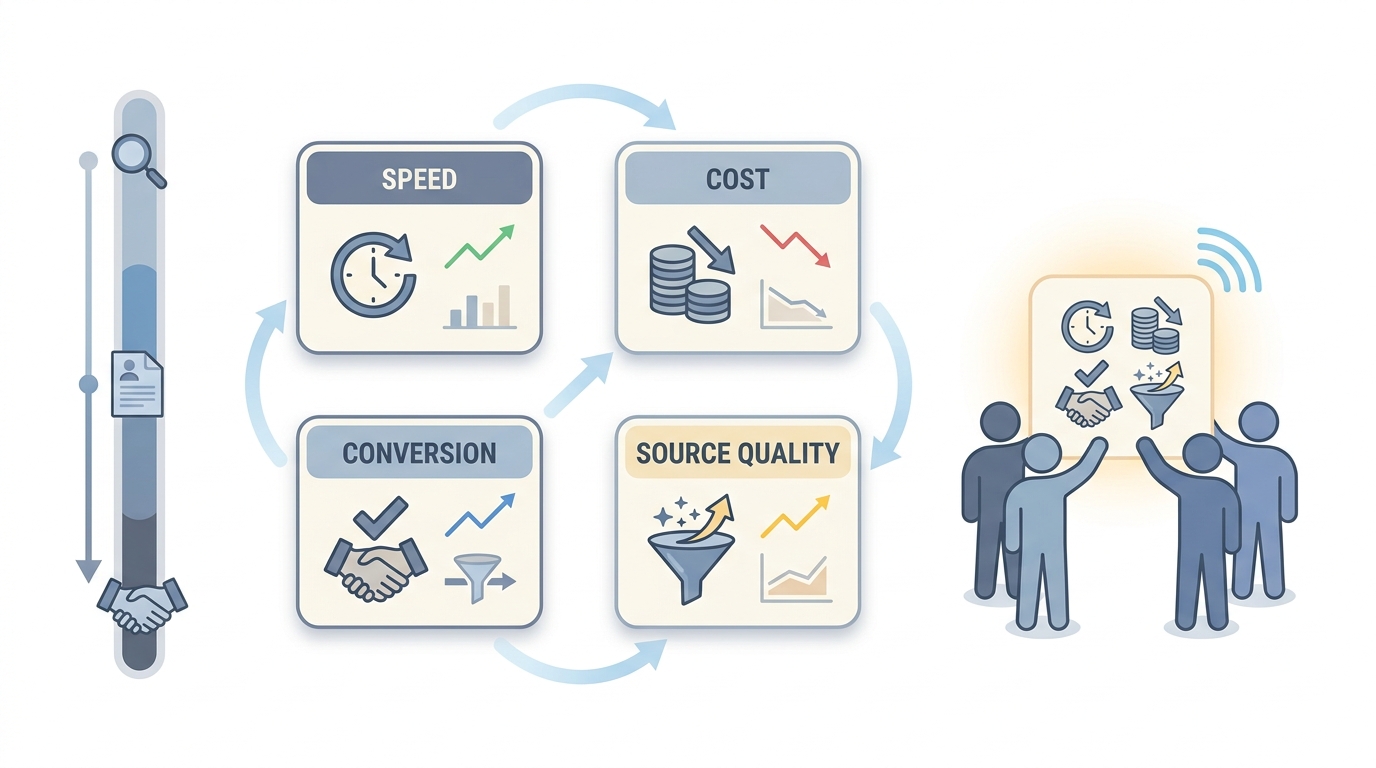
The KPIs and measurements TA teams track to understand recruiting performance: how fast roles fill, what each hire costs, where qualified candidates come from, and whether hires succeed after joining.
Michal Juhas · Last reviewed May 3, 2026
What are talent acquisition metrics?
Talent acquisition metrics are the numbers TA teams use to understand how recruiting is performing: how long roles take to fill, what each hire costs, which sources deliver candidates who make it to offer, and whether people hired are succeeding six months in.
In practice
- A TA leader at a 400-person tech company opens the weekly pipeline review with four numbers on a shared slide: time-to-fill by department, offer acceptance rate, cost-per-hire this quarter, and source-of-hire breakdown. Nothing else goes on the slide.
- After a bad quarter of offer declines, a recruiter pulls stage-by-stage drop-off data and finds that candidates who reached the final round waited an average of 11 days for feedback. No AI tool flagged it; the metric did.
- "Quality of hire" comes up every board cycle, but the definition shifts unless someone has pinned it to a 90-day manager survey from the HRIS. Ambiguity is the norm until TA names an owner for the definition.
Quick read, then how hiring teams use it
This is for recruiters, sourcers, TA, and HR partners who need the same vocabulary in debriefs, vendor calls, and policy reviews. Skim the first section when you need a fast shared picture. Use the second when you are deciding how metrics show up in dashboards, ATS configuration, or executive reporting.
Plain-language summary
- What it means for you: Talent acquisition metrics are the numbers that tell you and your stakeholders whether recruiting is working: how fast, how much, from where, and with what result after hire.
- How you would use it: Pick four or five metrics, define them once with Finance and HR Ops, and review them at a regular cadence so the team reacts to trends rather than surprises.
- How to get started: Pull time-to-fill and offer acceptance rate from your ATS for the last six months. Plot by department. The outliers will tell you where to look first.
- When it is a good time: Before any budget conversation or headcount planning cycle, and immediately after a spike in offer declines or longer-than-usual fill times.
When you are running live reqs and tools
- What it means for you: Metrics are only as reliable as your stage definitions in the ATS. Inconsistent use of "active," "on hold," or "offer extended" stages corrupts every downstream calculation.
- When it is a good time: When TA is being asked to defend headcount, justify tool spend, or connect recruiting output to business results.
- How to use it: Configure your ATS stages to match agreed definitions, build a shared data dictionary with Ops, and schedule a quarterly calibration where Finance and TA reconcile cost-per-hire numbers from different source systems.
- How to get started: Audit how your team currently moves candidates through stages. If two recruiters define "offer extended" differently, your average time-to-hire is wrong. Fix the process before you fix the dashboard.
- What to watch for: Vanity metrics (applications received, LinkedIn impressions) crowding out outcome metrics (offer acceptance, quality of hire, retention at 12 months). High application volume with low interview rate is a sourcing quality problem, not a success signal.
Where we talk about this
AI with Michal Workshops cover talent acquisition metrics in the context of AI-assisted recruiting: which numbers to surface in model prompts, how to structure ATS exports for analysis, and when AI-generated insights about pipeline health are trustworthy versus when they are guessing from bad input data. Come with your real ATS export and a metric your leadership does not agree on yet.
Around the web (opinions and rabbit holes)
Third-party creators move fast. Treat these as starting points, not endorsements, and double-check anything before you wire candidate data.
YouTube
- Talent Acquisition Metrics (AIHR) walks core KPIs and how to connect recruiting output to business results in a format built for HR practitioners.
- HR Metrics Every TA Leader Should Know (SHRM) covers the business case for consistent metric definitions across teams and geographies.
- How to Track Recruiting Metrics (Recruiting Daily Advisor) is practical if your ATS reporting is limited and you need to build a manual tracking layer first.
- What recruiting metrics do you report to leadership? in r/recruiting is one of the more honest threads about what TA leaders actually present versus what they wish they could.
- How do you calculate time to hire? in r/recruiting shows the definitional mess teams run into before standardizing stage definitions.
- Quality of hire - how do you measure it? in r/humanresources is a frank conversation about why quality of hire is the metric everyone wants and nobody agrees on.
Quora
- What are the most important metrics for talent acquisition? collects practitioner answers from TA leaders across company sizes (read critically for definition consistency).
Core metrics quick reference
| Metric | What it measures | Common pitfall |
|---|---|---|
| Time-to-fill | Req open to signed offer | Inconsistent "open" definition across teams |
| Time-to-hire | First contact to signed offer | Mixing with time-to-fill in the same report |
| Cost-per-hire | All spend divided by hires | Excluding internal recruiter time |
| Offer acceptance rate | Offers accepted / offers extended | Not segmenting by role level or function |
| Quality of hire | Post-hire performance indicators | No agreed definition between TA and HR Ops |
| Source of hire | Channel that produced the hire | Crediting last touch instead of first touch |
Related on this site
- Glossary: Talent acquisition (TA), Scorecard, Async screening, Candidate data enrichment, Workflow automation
- Blog: How to use AI in recruiting
- Guides: Sourcers, Hiring managers
- Course: Starting with AI: the foundations in recruiting
- Live cohort: Workshops
- Membership: Become a member