AI with Michal

Resume parsing

Software that turns unstructured CVs and profiles into structured fields in your ATS or CRM, usually with confidence scores and a human review path when extraction is uncertain.

Michal Juhas · Last reviewed May 3, 2026

What is resume parsing?

Resume parsing is the step where software reads CVs and job board profiles, then fills ATS fields like employer, dates, skills, and education. Good systems show confidence and route fuzzy rows to a human instead of silently guessing.
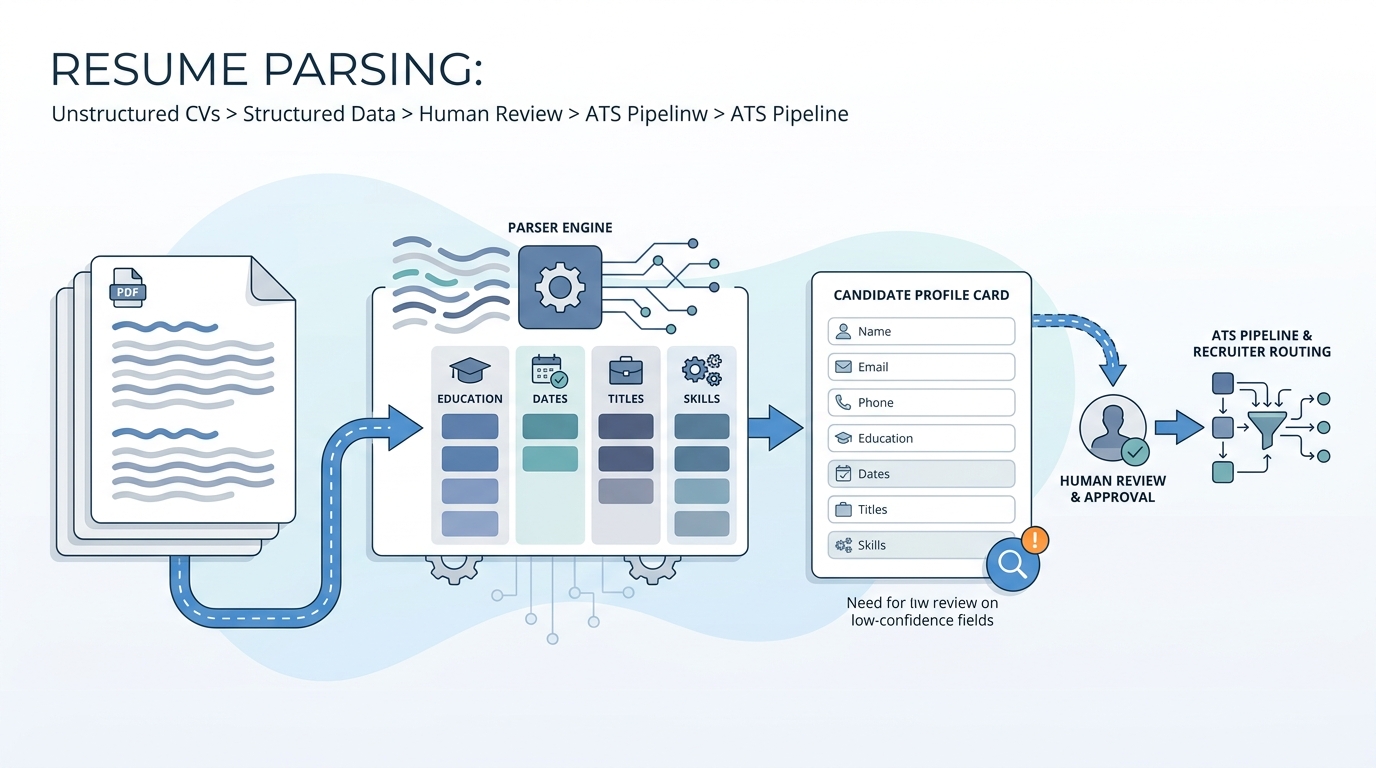
Illustration: generic resume pages flowing into a parser that fills structured profile fields, with a review stamp for uncertain extractions before an ATS-style card

In practice

  • Recruiters say "the parser mangled the title" when a two-column PDF collapsed into nonsense chips in the ATS.
  • Engineers refer to "OCR plus NER" when discussing the same feature set vendors market as AI resume intelligence.
  • TA ops schedules "reparse weekends" after vendor upgrades because historical rows suddenly need a new mapping.

Quick read, then how hiring teams use it

This is for recruiters, sourcers, TA, and HR partners who need the same vocabulary in debriefs, vendor calls, and policy reviews. Skim the first section when you need a fast shared picture. Use the second when you are deciding how it shows up in the ATS, sourcing tools, or candidate communications.

Plain-language summary

  • What it means for you: Software reads CVs and drops answers into database fields your team searches and reports on.
  • How you would use it: You tune field mappings, confidence thresholds, and review queues so recruiters trust the record.
  • How to get started: Export fifty recent failures, tag them by layout type, and open a ticket batch with your vendor.
  • When it is a good time: Before enabling auto-stage moves, after a template change, or when new languages launch.

When you are running live reqs and tools

  • What it means for you: Parsing is the foundation under matching, ranking, and analytics. Weak fields poison everything above.
  • When it is a good time: During ATS migration, when acquisition adds a new careers site, or when you add AI scoring downstream.
  • How to use it: Pair technical metrics with recruiter correction time so finance sees full cost, not only accuracy charts.
  • How to get started: Freeze new custom fields for one sprint while you remap exports and reindex search.
  • What to watch for: Silent truncation, duplicate candidates after reparse, and multilingual resumes falling back to English-only heuristics.

Where we talk about this

Sourcing automation and AI in recruiting tracks both touch parsing when discussing inbound volume and compliance. Bring redacted samples to Workshops.

Around the web (opinions and rabbit holes)

Third-party creators move fast. Treat these as starting points, not endorsements, and double-check anything before you wire candidate data.

YouTube

  • Search "resume parsing ATS" for vendor-agnostic walkthroughs of PDF layout problems and field mapping.
  • Search "NER resume machine learning" for deeper technical primers if your engineering partners want shared vocabulary.

Reddit

  • r/recruiting and r/recruitinghell surface candidate-side frustrations when parsers drop degrees or garble names; read for empathy and QA ideas.

Quora

  • Search "resume parser accuracy" for mixed quality threads; prefer answers that cite evaluation methodology over brand cheerleading.

Related on this site

Frequently asked questions

Why do parsed profiles still look messy after "AI"?
Models guess labels from noisy PDFs, multi-column layouts, and tables that were never meant for machines. Without strict schema rules, "skills" become sentence fragments and job titles duplicate three ways. You need normalization dictionaries, dedupe keys, and a visible queue for low-confidence cells before recruiters trust search. Pair parsing with structured output patterns when you call external models so JSON maps cleanly to your ATS columns. Log vendor version and prompt hash whenever bulk reparse jobs run so you can explain sudden shifts in match quality to hiring managers who noticed overnight.
When should humans review every parse?
Regulated industries, executive hires, and any workflow where a wrong start date triggers compliance risk deserve default review. High-volume hourly roles sometimes auto-accept above a confidence threshold if you measure dispute rate weekly. The policy should name who may override, how overrides are logged, and what happens when a candidate updates their CV mid-process. If you blend candidate data enrichment after parsing, sequence enrichment after human approval so bad extractions do not propagate. Train recruiters on how to fix fields without breaking audit trails.
How does parsing interact with search and match features?
Search quality caps at whatever tokens your parser wrote into the index. If skills land in a single blob, semantic search cannot save you. Invest in field-level indexing and language-aware stemming decisions before you buy another "AI matching" module. When vendors promise automatic tagging, ask which fields feed ranking models and whether recruiters can suppress tags per req family. Document which languages receive first-class models versus heuristic fallbacks so global teams do not discover gaps during campus season. Revisit mappings whenever hiring managers add custom questions that never flow into parsed fields today.
What GDPR questions come up first?
Lawful basis, retention of original files versus derived JSON, subprocessors that retrain on your data, and whether candidates can request human-readable explanations of automated classifications. Parsing plus scoring can edge toward automated decision-making in some jurisdictions, so legal should label each field. If you store embeddings, clarify retention and whether EU data leaves the tenant. Align answers with your DPA and careers site privacy copy so TA speaks consistently with marketing. Keep a deletion playbook that removes derived fields when the source CV is purged.
What is a pragmatic pilot design?
Pick one geography, one role family, and two intake channels (for example agency email and direct apply). Run dual entry with legacy forms for two weeks while you compare field-level accuracy, time-to-first-screen, and recruiter complaints. Capture screenshots of worst parses for vendor tickets instead of only aggregate accuracy. Publish success criteria up front, including maximum acceptable manual correction minutes per hundred applicants. If the pilot touches EU applicants, involve your DPO before you widen traffic. End with a written go or no-go that names owners for normalization rules left unfinished.
Where can we compare notes with other TA teams?
Bring sample error buckets to an AI in recruiting workshop so peers can suggest schema fixes you might miss internally. Read AI candidate screening with legal before you wire parsed fields into auto-stage moves. The foundations course (Starting with AI: the foundations in recruiting) helps recruiters ask vendors better questions about confidence scores and overrides. Membership office hours help when you are stuck between two ATS-native parsers and a standalone OCR vendor.

← Back to AI glossary in practice