AI hiring platform
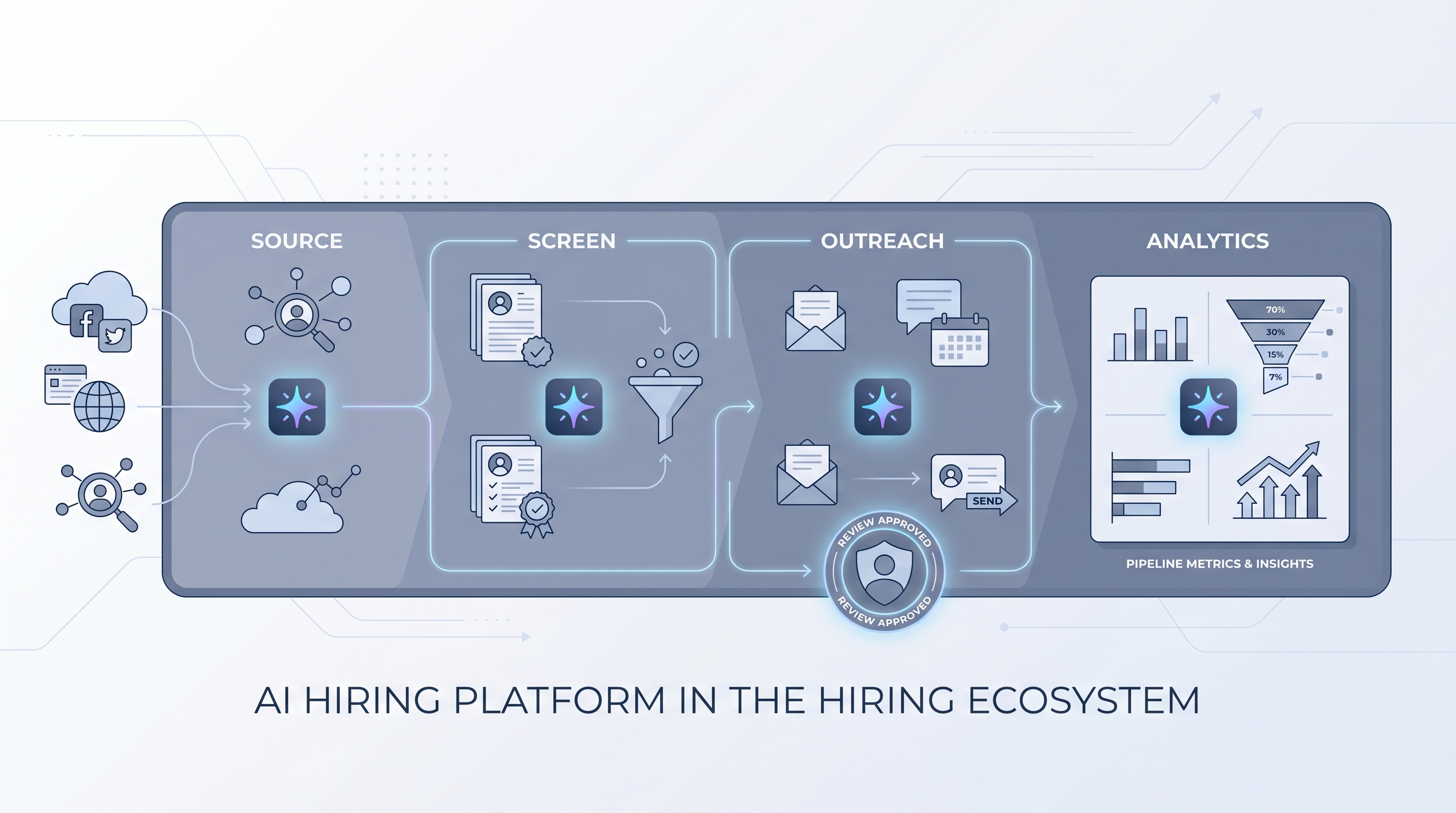
An integrated software platform that uses artificial intelligence across multiple stages of the hiring lifecycle, combining candidate sourcing, resume screening, outreach, interview scheduling, and pipeline analytics into one connected system rather than a collection of point tools.
Michal Juhas · Last reviewed May 4, 2026
What is an AI hiring platform?
An AI hiring platform combines candidate sourcing, resume screening, outreach, interview scheduling, and pipeline analytics into one connected system that uses artificial intelligence at multiple stages. Unlike point tools that solve one problem each, a platform shares candidate data and signals across the full funnel so context built in one stage carries forward to the next without manual exports or copy-paste.
The phrase is also used loosely in vendor marketing to mean any recruiting software with at least one AI feature. The meaningful distinction is integration: a genuine AI hiring platform changes how data moves between stages, not just how one step is performed.
In practice
- When a hiring manager says "we use Greenhouse AI" or "we have Ashby for everything", they are describing an ATS with embedded AI features that moves toward the platform category rather than a standalone tool per stage.
- A TA ops lead running a weekly pipeline review that pulls source quality, time-to-screen, and outreach reply rates from one dashboard, rather than three separate exports, is using a platform's data-sharing benefit.
- When a platform vendor advertises "AI-ranked shortlists and automated outreach sequences in one product", the critical question is whether a human review gate sits between the AI output and the candidate-facing action.
Quick read, then how hiring teams use it
This is for recruiters, TA leaders, and HR ops practitioners evaluating platforms, running vendor comparisons, or deciding whether to consolidate their stack. Skim the first part for shared vocabulary. Read the second when you are making a buy-or-build decision.
Plain-language summary
- What it means for you: An AI hiring platform is one product that handles sourcing, screening, outreach, scheduling, and reporting with AI built in across all of those steps, rather than four tools with a spreadsheet duct-taped between them.
- How you would use it: You set up job briefs, configure review gates, and the platform surfaces candidates, drafts messages, and tracks pipeline in one place. You review AI outputs before they touch candidates.
- How to get started: Map which stages your team currently loses the most time in before evaluating platforms. A platform that excels at sourcing but has weak scheduling may not be worth the consolidation if scheduling is your biggest bottleneck.
- When it is a good time: When you have stable hiring volume, clear review processes, and named owners for each stage. Platforms amplify whatever your team already does consistently.
When you are running live reqs and tools
- What it means for you: A platform approach means AI signals compound across stages: sourced candidate data enriches screening, screening patterns improve sourcing over time. That flywheel needs volume and stable process to spin.
- When it is a good time: After you have a human-in-the-loop review gate defined for each AI-influenced step, compliance sign-off on automated scoring, and a named TA ops owner for platform configuration.
- How to use it: Configure the platform around your existing scorecard definitions. Keep AI ranking and scoring outputs in a review queue before they change candidate status in your ATS. Log model versions quarterly for AI bias audit purposes.
- How to get started: Run a paid trial with three real active roles. Score on candidate quality surfaced, draft message quality, and data security posture. Include your IT security team in the vendor questionnaire before extending a trial.
- What to watch for: Vendor lock-in on candidate data, model drift between contract renewal cycles, and AI features that skip review queues and write directly to candidate records without a gate.
Where we talk about this
On AI with Michal sessions, AI hiring platform decisions come up in both the AI in recruiting track (full-funnel context) and the sourcing automation track (stack architecture). We evaluate platform versus point-tool trade-offs with real recruiting scenarios rather than vendor slide decks. If you are mid-decision and want peer pressure-testing, start at Workshops and bring your shortlist of platforms and your actual ATS constraints.
Around the web (opinions and rabbit holes)
Treat these as starting points, not endorsements. Verify compliance posture and data practices directly with each vendor before running candidate data through a trial.
YouTube
- AI in Recruiting: What Talent Teams Need to Know covers the TA context for evaluating AI features across recruiting platforms.
- AI Bias and Fairness Explained (IBM Technology) is useful background for evaluating any platform that scores or ranks candidates.
- Introduction to Generative AI (Google Cloud Tech) explains the model layer that powers most AI hiring platform features, helpful for stress-testing vendor claims.
- AI tools for recruiting: 6 months in, what worked and what did not in r/recruiting is candid about platform versus point-tool trade-offs in production.
- How are you actually using AI in your recruiting workflow right now? in r/recruiting includes practitioner takes on which platforms held up under real hiring volume.
- Has AI made recruiting easier or just different? in r/Recruitment covers the adoption reality behind platform marketing claims.
Quora
- What are the best AI tools for recruiting and hiring? collects platform recommendations with varying levels of real-world context.
Platform vs. point tools
| Dimension | AI hiring platform | Best-of-breed stack |
|---|---|---|
| Data sharing | Built-in across stages | Requires integrations or exports |
| Stage depth | Adequate at each step | Best-in-class per tool |
| Integration burden | Low once configured | Ongoing maintenance per tool |
| Vendor lock-in risk | High | Distributed |
| Best for | High volume, ops-light teams | High volume needing stage-specific power |
Related on this site
- Glossary: AI hiring software, AI recruiting tools, AI in recruiting, Applicant tracking software, Human-in-the-loop, AI bias audit, Semantic search, Scorecard
- Blog: AI sourcing tools for recruiters
- Guides: Sourcers
- Workshops: AI in recruiting
- Courses: Starting with AI: the foundations in recruiting
- Membership: Become a member