Competitor talent mapping
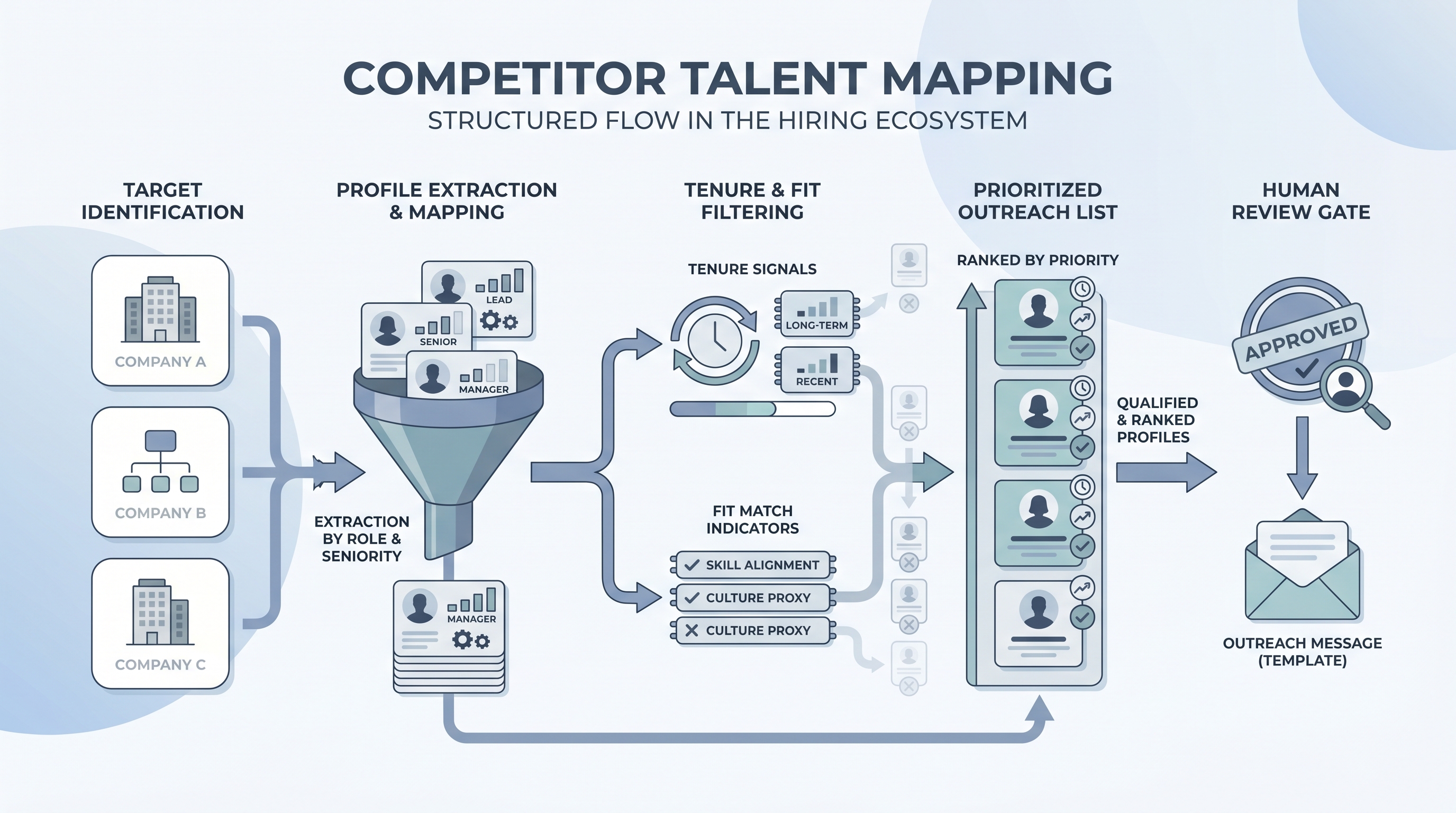
A structured research process that identifies and profiles talent at competitor or target companies - by role, seniority, tenure, and skill signal - to build a prioritized outreach list for sourcing specific functions or levels.
Michal Juhas · Last reviewed May 4, 2026
What is competitor talent mapping?
Competitor talent mapping is a structured research process that identifies and profiles talent at specific companies - usually competitors or companies known for building strong teams in a particular function - to build a prioritized outreach list for sourcing specific roles or levels.
The map is intelligence work that happens before outreach work. Without it, sourcers launch cold searches against the full market. With it, they start from a prioritized list of people who are known to have the right background, are past the tenure threshold where openness is highest, and are approachable through a channel the sourcer controls.
In practice
- A sourcer building a pipeline for a senior product manager role maps five companies known for strong product teams, profiles 40 current PMs by tenure and scope, and narrows to 18 who are past the two-year mark and recently visible in a product community. The outreach rate is 35% positive response because the list is precise, not because the message is extraordinary.
- A TA lead uses competitor talent mapping before a new engineering function launch: she identifies which companies have scaled the exact technical capability the hiring manager wants, maps 12 current incumbents, and uses those backgrounds to refine the ideal candidate profile before writing the JD.
- A sourcer skips mapping and sends 200 InMails to anyone with the right title. Response rate is 8%. The sourcer who mapped first sends 25 messages and gets 11 positive replies. The difference is targeting, not volume.
Quick read, then how hiring teams use it
This is for sourcers, full-cycle recruiters, and TA leads who want to run more targeted campaigns and reduce the wasted sends that come from unstructured outreach. Skim the first section for shared vocabulary. Use the second when building a sourcing strategy for a specific req or function.
Plain-language summary
- What it means for you: Competitor talent mapping is how you know where to look before you start looking. It turns "source engineers in Berlin" into "contact these 25 people at these three companies, prioritized by tenure and recent activity."
- How you would use it: Pick three to five target companies for your open req, map 30 to 50 current incumbents in the target role, apply tenure and signal filters, and start outreach with the top 20 to 25.
- How to get started: Open LinkedIn Sales Navigator or a comparable tool for your target function. Search by company, title, and seniority. Export the list and sort by tenure. Everyone past 2.5 years who matches your ICP goes to the top of your outreach queue.
- When it is a good time: Before any specialized or mid-to-senior role where the passive market is small and generic job board sourcing will not surface the right profiles at sufficient volume.
When you are running live reqs and tools
- What it means for you: At scale, competitor talent mapping feeds AI outreach drafting with the specific context needed for personalization: current company, role scope, tenure, and any visible signal of change. Without the map, AI personalization is generic; with it, messages reference real context.
- When it is a good time: Before launching a sourcing campaign for a niche or senior role, before building a proprietary talent pool for a recurring function, and when response rates on existing outreach have plateaued and better targeting is the variable to change.
- How to use it: Feed the prioritized map into your outreach tool or AI drafting workflow. Include tenure, current role scope, and any activity signals in the prompt context so personalization is based on real profile data, not inferred generalities. Log which map and which message variant each batch used so you can trace response rate changes to targeting decisions rather than message quality.
- How to get started: Build one competitor map end-to-end before automating it. Map 30 profiles manually, apply your filters, draft the first ten messages yourself, then measure response rate against your last generic campaign to the same function. The comparison will tell you whether the targeting lift justifies the mapping investment for this req type.
- What to watch for: Hallucination in AI-generated competitive intelligence: models can produce plausible-sounding headcount estimates, team structure descriptions, or company background that is factually wrong. Verify any AI-generated research against the company careers page and LinkedIn before building targeting decisions on it.
Where we talk about this
AI with Michal sourcing automation workshops cover competitor talent mapping as a structured exercise: how to scope a map for a specific req, which data signals matter for prioritization, and how to turn a finished map into AI-ready input for personalized outreach. Come with a current open role and a list of target companies and we will build the first version in the session.
Around the web (opinions and rabbit holes)
Third-party creators move fast. Treat these as starting points, not endorsements, and double-check anything before you wire candidate data.
YouTube
- How to Map Talent at Competitor Companies (sourcing practitioners) walks the end-to-end mapping process from company identification through outreach list build.
- LinkedIn Boolean for Competitor Mapping shows how to combine Boolean search strings with company filters to build targeted competitor maps efficiently.
- Talent Intelligence and Competitor Analysis for TA (DottoTech / TA practitioners) covers the data sources and signal prioritization that experienced sourcers use to map talent systematically.
- How do you build a competitor talent map? in r/recruiting has practitioner responses on methodology and data source choices.
- Legal concerns around targeting competitor employees in r/humanresources surfaces GDPR and platform terms of service questions with practitioner and legal perspectives.
- AI tools for talent mapping and intelligence in r/RecruitmentAgencies covers which AI tools agencies actually use for competitive talent research.
Quora
- How do recruiters map talent at competitor companies? collects sourcer and TA practitioner answers on methodology and tooling (read for context-specificity before drawing conclusions).
Competitor talent mapping process
| Stage | What you do | Tool or signal |
|---|---|---|
| Target identification | Pick 3-5 companies with the right talent density | Market knowledge, LinkedIn company search |
| Profile extraction | Map 30-50 incumbents by role and seniority | LinkedIn Sales Navigator, Boolean search |
| Tenure filtering | Prioritize candidates past 2-3 year mark | Filter by start date |
| Signal scoring | Flag recent activity, promotion, or visible change | Post activity, title updates |
| Outreach prioritization | Build a ranked list of 20-25 top targets | Manual review or semantic scoring |
Related on this site
- Glossary: Ideal candidate profile sourcing, Candidate data enrichment, Boolean search, Semantic search, Proprietary talent pool
- Blog: AI sourcing tools for recruiters
- Guides: Sourcers
- Course: Starting with AI: the foundations in recruiting
- Live cohort: Workshops
- Membership: Become a member