Ideal candidate profile for sourcing
A documented set of must-have skills, experience signals, target companies, and deliberate exclusion criteria that a sourcing team and hiring manager agree on before any outreach begins.
Michal Juhas · Last reviewed May 4, 2026
What is an ideal candidate profile for sourcing?
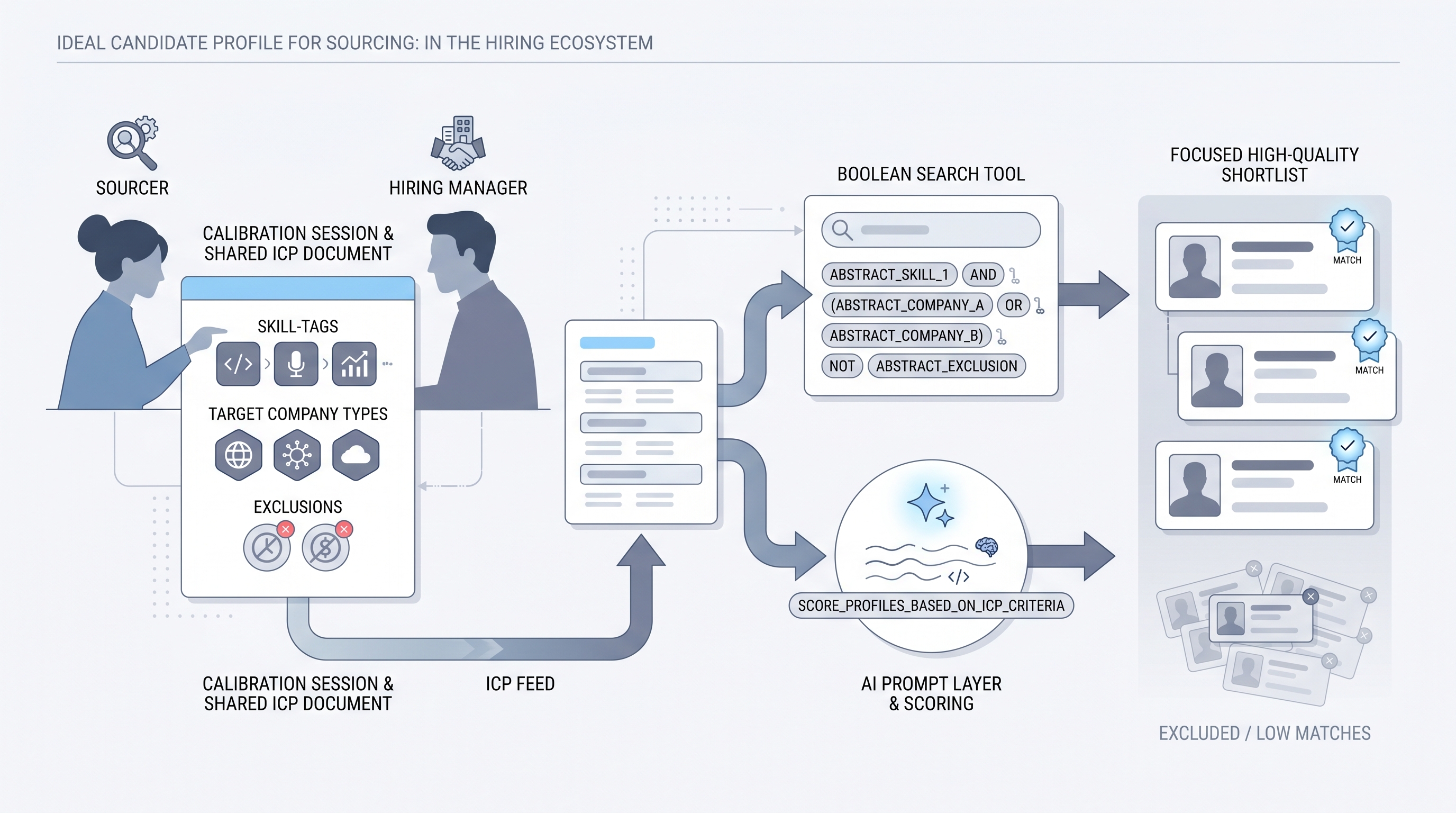
An ideal candidate profile (ICP) is the internal targeting brief a sourcer and hiring manager build together before any search begins. It answers the question sourcers need answered, not the one candidates ask: given a talent pool, which profiles are worth approaching? The ICP captures must-have skills, experience range, target company or industry signals, role-scope requirements, and deliberate exclusion criteria that keep sourcing consistent and legally defensible.
In practice
- A sourcer opening a new engineering req might say "I need the ICP before I write a Boolean string" in the same way a recruiter says "I need the job description before I post." The ICP is the sourcer's version of that first document.
- On recruiting podcasts, the phrase "calibration call" usually refers to the conversation where the hiring manager and sourcer align on the ICP, even when neither party uses that exact term.
- When a hiring manager says "the profiles you're sending look totally different from what I had in mind," that is almost always an ICP problem rather than a sourcing execution problem.
Quick read, then how hiring teams use it
This is for recruiters, sourcers, TA leads, and hiring managers who need the same vocabulary in kick-off calls, pipeline reviews, and tooling decisions. Skim the first section when you need a fast shared picture. Use the second when you are deciding how the ICP connects to your ATS, AI prompts, or outreach tools.
Plain-language summary
- What it means for you: A short agreed document that tells your sourcing team who to look for and who to skip, so everyone works from the same criteria rather than personal guesses.
- How you would use it: Before opening a search tool or an AI prompt, write down the three to five signals that define a strong candidate and the one or two patterns that predict a poor fit. Share it with everyone on the req.
- How to get started: Ask your hiring manager to name the two best people in a similar role they have worked with and explain what set them apart. That answer is usually your ICP draft.
- When it is a good time: Any time a new req opens, or when the current shortlist is producing consistent "not quite right" feedback from the hiring team.
When you are running live reqs and tools
- What it means for you: The ICP becomes the context layer for your AI tools. Paste it into a system prompt or a RAG document and every screening run, Boolean search draft, and outreach template will be anchored to agreed criteria rather than model defaults.
- When it is a good time: Before the first Boolean string is written and before the first AI scoring prompt is configured. Retrofitting an ICP mid-sprint is possible but expensive, since you will need to re-score profiles already reviewed against looser criteria.
- How to use it: Store the ICP as a versioned document in a shared Google Doc or a note in your ATS. Reference it explicitly in your AI instructions and update it every time the hiring manager shifts priorities. Log which version was active when each profile was reviewed for a defensible audit trail.
- How to get started: Run a thirty-minute calibration call with the hiring manager before sourcing begins. Use the output to fill four fields: target companies or industries, must-have skills or scope, must-not backgrounds, and the one or two signals that indicate trajectory rather than tenure.
- What to watch for: ICP drift, where the hiring manager gradually raises standards as good profiles come in or lowers them when the pipeline is thin, without updating the document. Both create inconsistency and adverse impact risk if the undocumented changes correlate with protected characteristics.
Where we talk about this
On AI with Michal live sessions, the ideal candidate profile sits at the centre of both tracks: the AI in recruiting block covers how to translate an ICP into AI screening prompts and how to catch model drift from your criteria, and the sourcing automation block covers wiring the ICP into workflow automation so every outreach sequence stays on-brief. If you want the full room conversation, start at Workshops and bring your most recent brief.
Around the web (opinions and rabbit holes)
Third-party creators move fast. Treat these as starting points, not endorsements, and double-check anything before you wire candidate data.
YouTube
- Ideal candidate profile recruiting for current tutorials from sourcing educators covering must-have versus nice-to-have frameworks.
- SourceCon sessions on YouTube surface conference talks on targeting criteria and calibration techniques from experienced sourcers.
- Glen Cathey + Shally Steckerl sourcing turns up recorded talks on sourcing criteria and Boolean targeting worth watching before you build your first ICP.
- r/recruiting has recurring threads on calibration calls and why shortlists go wrong, with practitioner comments from in-house and agency sourcers.
- r/Talent collects discussion on TA strategy including how sourcers document and apply targeting criteria before outreach begins.
Quora
- How do sourcers decide which candidates to reach out to? collects a range of practitioner answers on criteria-setting before outreach (quality varies, so read critically).
ICP versus job description
| Dimension | Job description | Ideal candidate profile |
|---|---|---|
| Written for | Candidates to self-select | Sourcers to recognise fit |
| Contains | Responsibilities, requirements, benefits | Target signals, must-nots, calibration examples |
| When created | Before posting | Before sourcing |
| Bias risk | Coded language in requirements | Over-indexing on pedigree or tenure |
Related on this site
- Glossary: Boolean search, Scorecard, Outbound talent sourcing, Candidate data enrichment, Semantic search, RAG, Adverse impact
- Blog: AI sourcing tools for recruiters
- Guides: Sourcers
- Live cohort: Workshops
- Course: Starting with AI: the foundations in recruiting
- Membership: Become a member