Employee onboarding tools
The connected set of software categories that together move a new hire from offer acceptance through paperwork, system provisioning, early training, and peer introductions, including onboarding portals, e-signature platforms, learning management systems, IT provisioning integrations, and AI-powered assistants.
Michal Juhas · Last reviewed May 5, 2026
What is an employee onboarding tool?
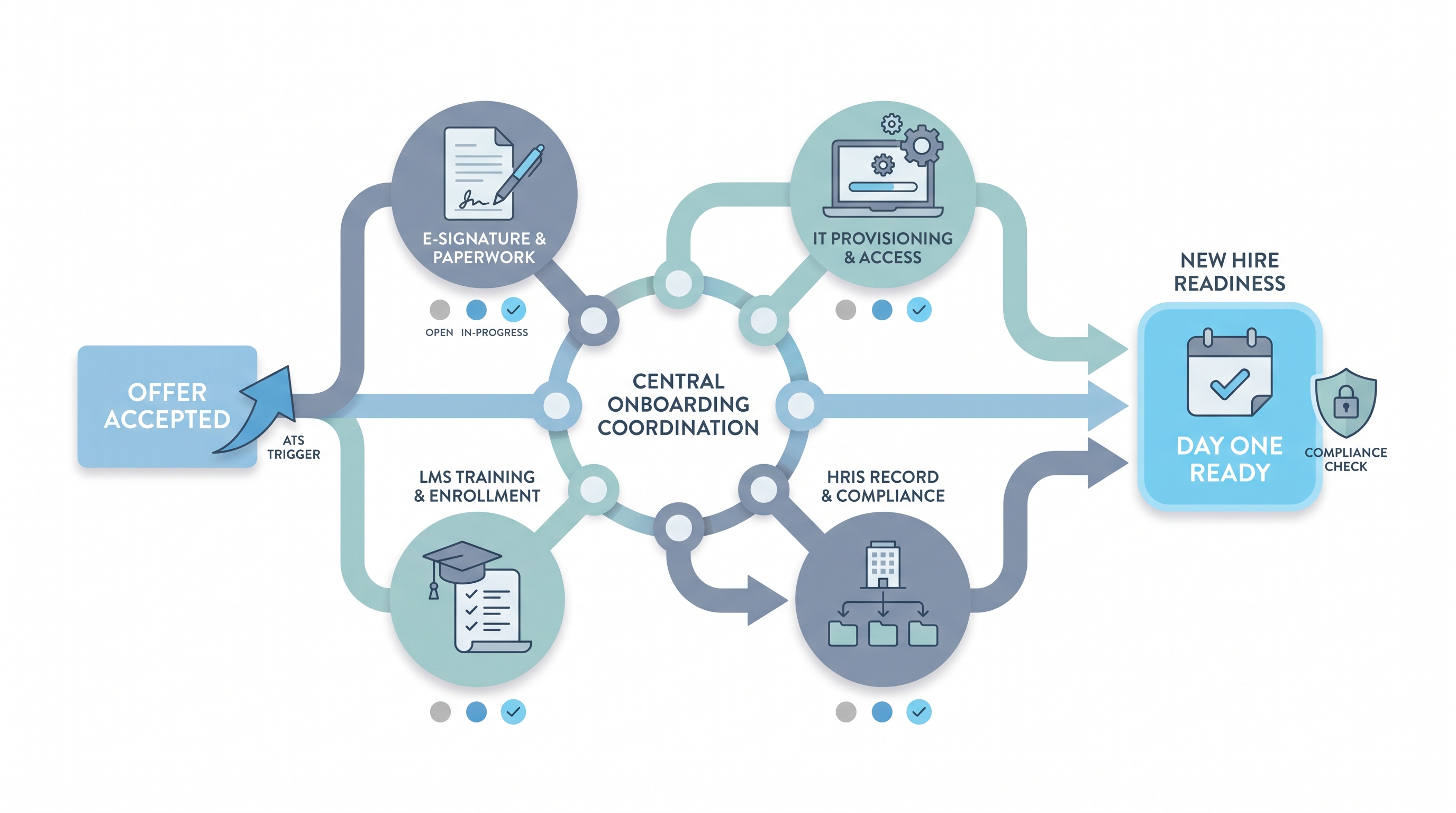
Employee onboarding tools are the software categories a team connects to move a new hire from offer acceptance to full productivity. The term covers more than a single checklist platform: e-signature tools collect policy acknowledgements, IT provisioning integrations trigger system access before the first day, learning management systems deliver role-specific training, HRIS modules create the employee record, and optional new hire portals give candidates a landing spot before orientation.
Most companies run three to five tools in sequence rather than a single all-in-one, which means the quality of handoffs between platforms shapes the new hire experience more than any individual product.
In practice
- An HR coordinator says "onboarding is done" and means paperwork and system access are complete. The hiring manager means the new hire understands team norms and has a first project. These two definitions point to different tools in different teams, and no single platform bridges them without explicit setup.
- A head of People at a 60-person company wired a US-only I-9 verification step into their global onboarding platform, then hired their first employee in Germany. The verification step blocked the entire task sequence because the tool assumed a US Social Security number as a required field.
- "The laptop was not ready" is the most common first-week complaint. It almost always traces to an IT provisioning task that existed in the onboarding platform but routed to a shared inbox IT does not monitor, rather than to the ticketing system where the request would have been seen.
Quick read, then how hiring teams use it
This is for HR business partners, TA leads, and People Ops teams who need to evaluate, configure, or set policy for onboarding tools. Skim the first section for a shared definition. Use the second for decisions about integration, AI features, and compliance.
Plain-language summary
- What it means for you: Onboarding tools are the shared systems that make sure HR, IT, and managers each know what they own before the new hire starts. When they work together, no one chases email threads to find out if the laptop shipped.
- How you would use it: Map every onboarding step on paper first: who owns it, which tool handles it, and what deadline it has relative to the start date. Then configure the tools against that map, not the other way around.
- How to get started: Pull a completion report from your last five onboarding runs. Find the step with the highest overdue rate. Fix the owner assignment or the tool integration at that step before adding AI features on top.
- When it is a good time: From your second or third hire onward, or whenever more than one team is involved and coordination is already costing someone two hours a week.
When you are running live reqs and tools
- What it means for you: Onboarding tools are integration points as much as checklists. They receive data from the ATS, trigger provisioning in IT systems, and feed the HRIS. Each handoff can fail silently if the field mapping is wrong or an API call retries without alerting anyone.
- When it is a good time: After your onboarding template is stable and the same workflow runs correctly for at least five hires in a row, then wire the ATS-to-onboarding integration and the IT provisioning trigger on top of a working foundation.
- How to use it: Map every task to a specific named owner, not a team inbox. Add a human-in-the-loop checkpoint for AI-generated content (personalized plans, policy summaries) before the new hire sees it. Log compliance-critical steps (I-9, GDPR acknowledgement) with timestamps you can export for an audit.
- How to get started: Run one full dry-run on a test profile before the first live hire. Confirm that IT provisioning requests land in the actual ticketing system IT monitors, not in an onboarding inbox nobody checks. See workflow automation for webhook retry and dead-letter patterns that apply here.
- What to watch for: Silent handoff failures when the ATS sync fires but a required field is blank; IT provisioning tasks that route to a shared inbox IT does not monitor; and AI-generated onboarding plans that reach the new hire before the hiring manager has reviewed them.
Where we talk about this
On AI with Michal live sessions we cover the post-hire handoff in the AI in recruiting track: how ATS data flows into onboarding templates, where automation routers can trigger IT provisioning without email chains, and how to add a policy chatbot scoped to internal documents without exposing HR data to a public model. If you want the full room conversation including real stack questions and integration failures from practitioners, start at Workshops and bring your current onboarding tool map.
Around the web (opinions and rabbit holes)
Third-party creators move fast in this space. Treat these as starting points, not endorsements. Verify tool capabilities and compliance postures directly with vendors before connecting employee data.
YouTube
- Search "employee onboarding process step by step" for HR practitioner walkthroughs that map the process before configuring any tool, which prevents wiring a broken flow into a capable platform.
- Search "onboarding software integration ATS HRIS" for ops-focused walkthroughs covering how task routing platforms connect to applicant tracking and payroll systems in practice.
- Search "AI chatbot employee onboarding" for practitioner reviews of policy Q&A bots in HR contexts, useful vocabulary before evaluating any vendor offering automated new hire support.
- What onboarding software does your company use? in r/humanresources collects candid practitioner opinions on tools across company sizes.
- What are your new hire onboarding horror stories? in r/humanresources surfaces the IT provisioning and template failures that vendor demos never show.
- First employee -- how did you handle onboarding? in r/startups is a frank starting-point thread from founders coordinating HR, IT, and legal for the first time.
Quora
- Search Quora for "best employee onboarding tools small business" for practitioner comparisons across budget ranges and HRIS combinations (verify claims directly with vendors before committing).
All-in-one versus best-of-breed onboarding stack
| Dimension | All-in-one platform | Best-of-breed stack |
|---|---|---|
| Setup time | Faster to first hire | More integration work up front |
| Team fit | One UI for all teams | Each team uses the system they already know |
| Integration risk | Vendor manages most connections | Each integration is your responsibility |
| Flexibility | Limited when one module is weak | Can swap weak tools independently |
| Cost at small scale | Often lower per seat | Lower per tool, but integration cost is real |
Related on this site
- Glossary: Employee onboarding software, Applicant tracking software, Workflow automation, Human-in-the-loop, Talent acquisition, Talent acquisition metrics
- Blog: AI sourcing tools for recruiters
- Guides: Sourcers
- Workshops: AI in recruiting
- Course: Starting with AI: the foundations in recruiting
- Membership: Become a member