Employee referral sourcing activation
A structured approach to turning a passive referral program into an active sourcing channel: targeting the right employees, giving them a specific role ask, and tracking referred candidates from first introduction to hire.
Michal Juhas · Last reviewed May 5, 2026
What is employee referral sourcing activation?
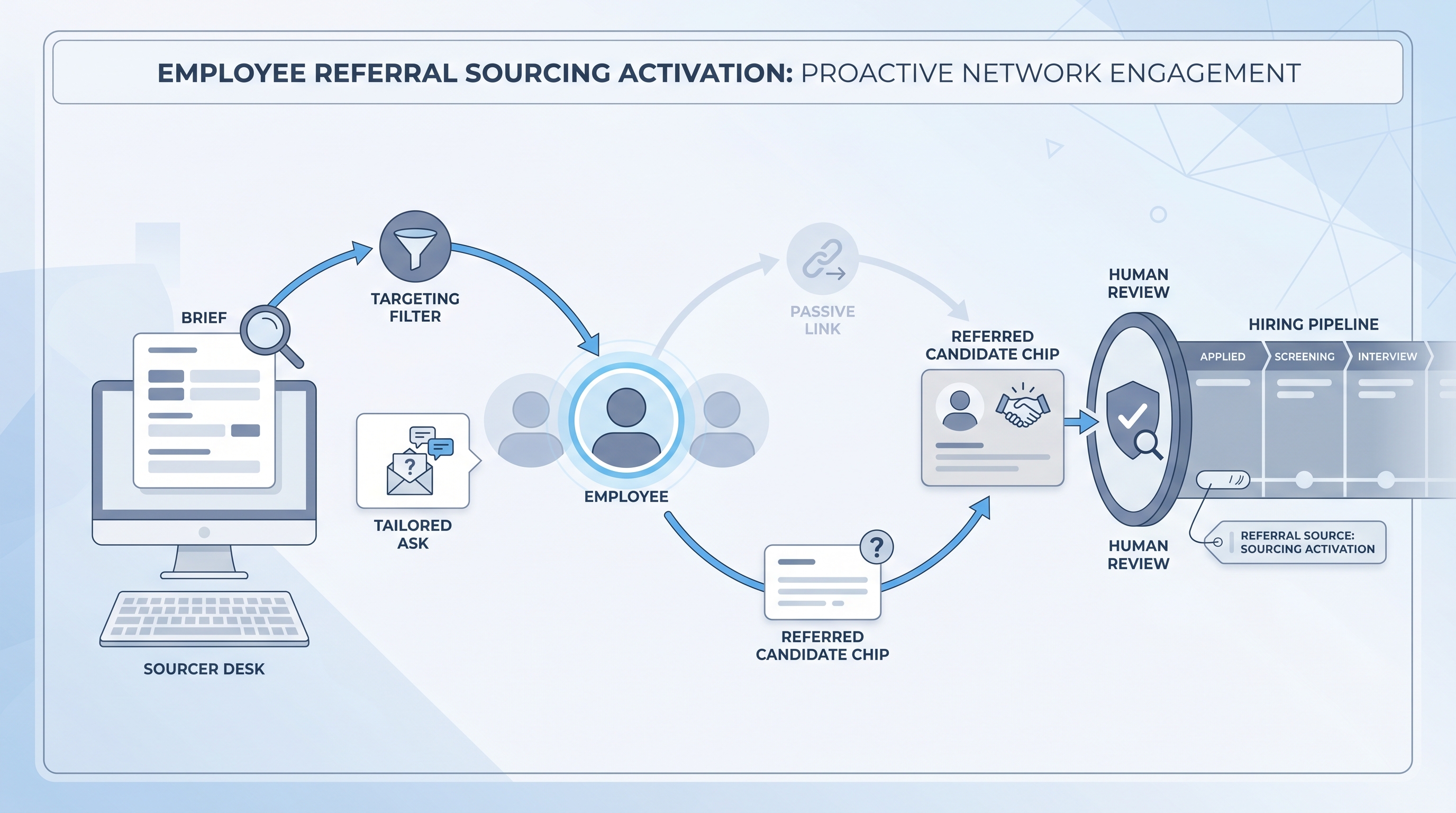
Employee referral sourcing activation turns a passive referral link into a proactive sourcing channel. The sourcing team identifies which employees are likely to know the right people for a specific open role, sends them a targeted ask with a clear role brief, and tracks referred candidates from introduction to hire. The difference from a standard referral program is intention: activation treats referrals as a sourcing motion, not a benefits perk. That means deciding who to ask, when, and with what context, rather than relying on employees to remember a form they bookmarked months ago.
In practice
- A sourcer building a pipeline for a senior data engineer checks which employees previously worked at two target companies and sends them a two-paragraph ask with a clear profile of who would be a good fit, rather than a generic "we're hiring" message.
- A TA team that tracks referral source-of-hire notices that three employees consistently refer candidates who reach the offer stage and prioritizes those employees for early outreach on new reqs in their network area.
- An HR partner coaching a hiring manager might say "let's activate your referral network this week" to mean: identify five former colleagues who might fit, send them a short ask, and log each response in the ATS so it is tracked.
Quick read, then how hiring teams use it
This is for sourcers, TA partners, and HR business partners who need shared vocabulary in kickoffs, debrief reviews, and vendor conversations. Skim the first section for a fast shared picture; use the second when you are running live reqs and deciding how referral activation fits into your sourcing mix.
Plain-language summary
- What it means for you: Instead of hoping employees remember a referral link, you identify the colleagues most likely to know someone and ask them directly with a short role brief.
- How you would use it: You open a new req, look at which employees have backgrounds connected to the target talent pool, write a two-paragraph ask, and track every name that comes back in the ATS.
- How to get started: Pull your last three referral hires and ask who referred them and why. That employee profile is your starting point for deciding who to activate first on the next similar req.
- When it is a good time: When a role is specialized, when you have a clear target company list, or when the inbound pipeline is thin and you want warm candidates faster than a job post typically delivers.
When you are running live reqs and tools
- What it means for you: Referral activation adds a sourcing motion to what most companies treat as a passive benefit. You are sourcing through employee networks with the same targeting discipline you would apply to outbound talent sourcing.
- When it is a good time: At the opening of a req, when you have a proprietary talent pool that is thin for a skill area, or when cost-per-hire on a role type is high and referral conversion rates justify the ops investment.
- How to use it: Use an AI model to draft the employee ask based on the role brief and ideal candidate profile. Keep a human review gate: a sourcer checks the draft before any employee receives it. Log the referral in the ATS at the sourced stage even when it came through a direct conversation rather than a link.
- How to get started: Map your last twelve months of referral data: who referred whom, what stage they reached, and which referrers were highest-signal. Build a short targeting list of those employees and approach them first on the next similar open req.
- What to watch for: Diversity risks when referral networks replicate existing team demographics, GDPR exposure when employees share contact details without the referred person's consent, and ATS tracking gaps that make it impossible to measure referral quality or pay bonuses correctly.
Where we talk about this
On AI with Michal live sessions, referral sourcing activation comes up in both the sourcing automation and AI in recruiting tracks: the sourcing automation block covers how to build the targeting logic and draft the employee ask, while the AI in recruiting block connects referral data to broader pipeline metrics and hiring manager trust. If you want the full room conversation with real stack questions, start at Workshops and bring your current referral submission and conversion numbers.
Around the web (opinions and rabbit holes)
Third-party creators move fast. Treat these as starting points, not endorsements, and double-check anything before you wire candidate data.
YouTube
Search YouTube for "employee referral program recruiting strategy" to find TA ops practitioners walking through activation frameworks, bonus timing, and tooling setups. Channels covering HR tech and sourcing strategy tend to be most relevant; look for content that distinguishes proactive targeted asks from passive link programs.
- r/recruiting and r/humanresources carry recurring threads on what makes referral programs produce hires versus just goodwill noise. Search "referral program" inside each subreddit for practitioner debate on bonus timing, quality versus quantity, and diversity tradeoffs.
- r/RecruitmentAgencies often has franker "does this actually work" threads from people running referral programs in high-volume environments.
Quora
- Search Quora for "how to improve employee referral program recruiting" for a wide range of practitioner answers covering activation tactics, bonus design, and ATS tracking. Quality varies; cross-check claims against your own program data before acting.
Passive referral program versus activated referral sourcing
| Dimension | Passive program | Activated sourcing |
|---|---|---|
| Ask timing | Any time via a link | First week of req opening |
| Who is asked | All employees | Targeted by network fit |
| Role information | Generic job title | Short tailored brief |
| ATS tracking | Often missing | Logged at sourced stage |
| Diversity audit | Rarely done | Quarterly at shortlist |
Related on this site
- Glossary: Outbound talent sourcing, Proprietary talent pool, Ideal candidate profile sourcing, Multi-channel talent sourcing, Contact enrichment sourcing, GDPR first touch outreach
- Blog: AI sourcing tools for recruiters
- Guides: Sourcers
- Live cohort: Workshops
- Membership: Become a member