AI recruitment software
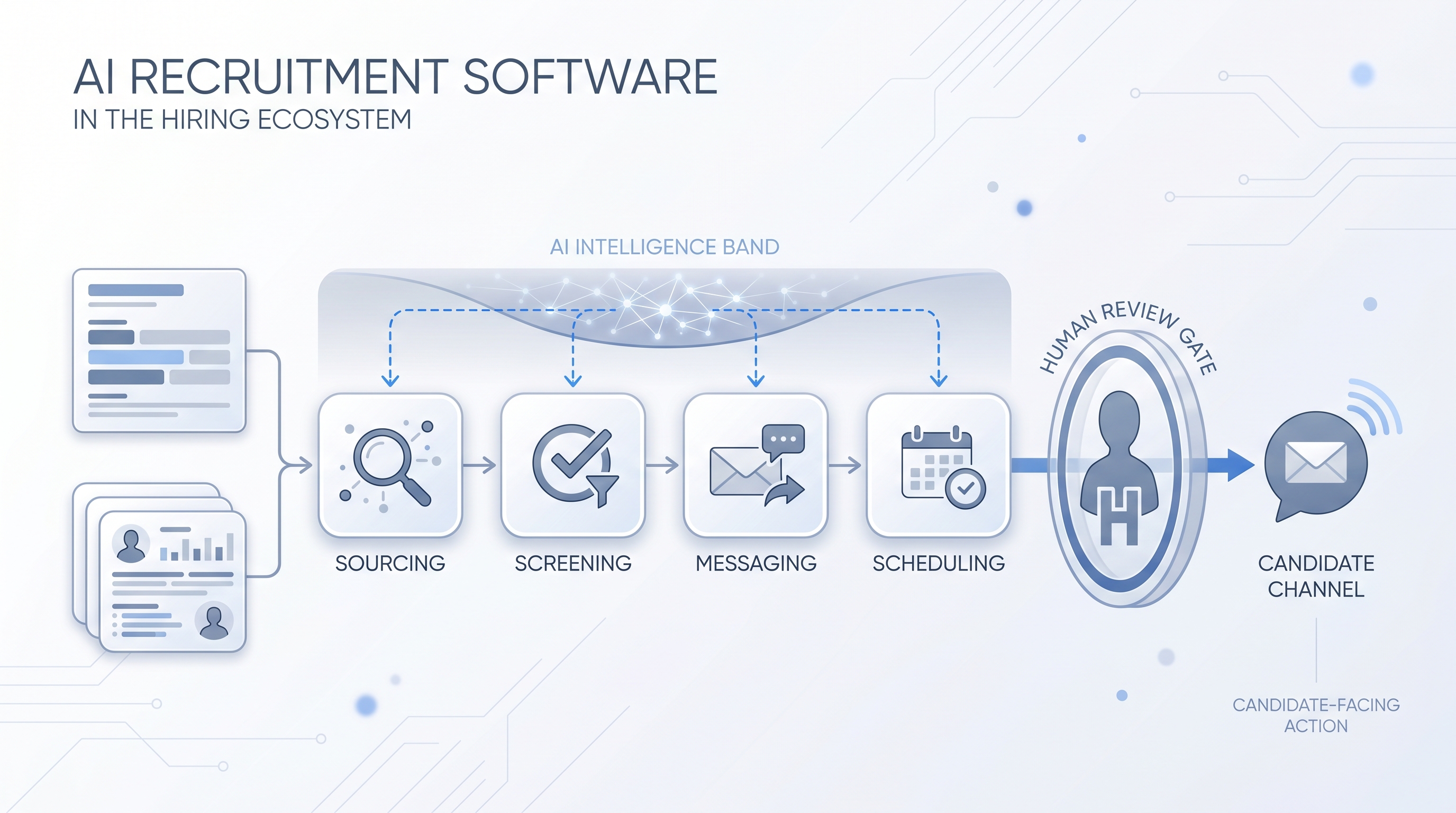
Software that applies artificial intelligence to one or more stages of the recruiting process, from sourcing and resume screening to candidate communication and pipeline analytics, rather than relying on purely rule-based filtering or manual work.
Michal Juhas · Last reviewed May 4, 2026
What is AI recruitment software?
AI recruitment software covers any tool that uses artificial intelligence to assist or automate at least one step in the recruiting process. That includes single-purpose tools like a CV parser, a sourcing extension, or a scheduling bot, as well as integrated AI recruitment platforms that connect sourcing, screening, and scheduling in a single system.
What separates AI recruitment software from older rules-based tools is inference: the software generates a ranking, drafts a message, or extracts structured data based on model reasoning rather than criteria you preset. That distinction matters for how you evaluate, calibrate, monitor, and govern the tool.
In practice
- A TA lead reviewing a software demo says "this looks like AI" because the shortlist appeared without manual filtering; the real question is which model generated it, on what training data, and who reviews the output before it affects a candidate.
- A sourcer says their new AI recruitment software "does not know our market" when the ranking puts senior profiles below junior ones on a niche technical req; that is a calibration problem, and the fix is feedback loops and model tuning, not a new tool purchase.
- An HRBP asking procurement "does this tool make automated decisions about candidates" is asking a compliance question every AI recruitment software vendor should be able to answer in writing before the contract is signed.
Quick read, then how hiring teams use it
This is for recruiters, sourcers, TA leads, HR ops, and HRBPs who are evaluating, buying, or governing AI recruitment software. Skim the first section for a shared vocabulary. Use the second for operational and procurement decisions.
Plain-language summary
- What it means for you: AI recruitment software is any tool where a model reasons over your data to surface candidates, draft text, or fill fields rather than following rules you configured step by step.
- How you would use it: Match the tool to the stage that costs the most recruiter time per week. Drafting, sourcing, and high-volume CV triage tend to return value fastest when the model is calibrated to your role types.
- How to get started: Map your current stack by stage and note for each tool whether any AI feature is active, calibrated, and reviewed by a human before it affects a candidate. Most teams find one or two live AI features nobody is monitoring.
- When it is a good time: Before any new software purchase, or when a compliance review asks which of your tools makes inferences about candidates.
When you are running live reqs and tools
- What it means for you: Every AI recruitment tool that generates a score, summary, or message is making model-based inferences that can contain bias, errors, or outdated assumptions, regardless of how confident the output looks.
- When it is a good time: Before you let any AI output influence who advances past a funnel gate without human review. That is where bias risk, GDPR automated decision rules, and data residency obligations converge.
- How to use it: Log model version and prompt hash for every AI output that influences a candidate decision. Add a review gate before any AI-generated message goes out and before any AI-generated score feeds a shortlist. Review those logs monthly.
- How to get started: Pull a one-line audit of each AI feature your team currently uses: which model runs it, who last reviewed the outputs, and whether the vendor updated the model in the last six months without notifying you.
- What to watch for: Vendors that fold AI into existing tools at renewal without reopening the DPA. AI-generated summaries copied into rejection decisions without a human reading the source CV. Integration changes that silently alter how candidate scores are calculated.
Where we talk about this
On AI with Michal live sessions the software evaluation conversation runs through both tracks. AI in recruiting workshops cover which tool categories actually save recruiter time, what questions to put to vendors, and where human review gates belong in the pipeline. Sourcing automation sessions go deeper on integrations: how AI tools hand off data, which fields break across APIs, and what fails when a vendor updates a model mid-campaign. Bring your current stack and the tool you are unsure about to Workshops for a peer reality check.
Around the web (opinions and rabbit holes)
Third-party creators cover AI recruitment software at high volume. Treat these as starting points, not endorsements, and verify compliance postures and feature claims with vendors before committing to a contract.
YouTube
- AI in Recruiting: What You Need to Know pulls recent practitioner walkthroughs of AI tools across sourcing, screening, and scheduling stages.
- How recruiters evaluate AI software shows real workflows from TA leads who have run trials against their own candidate data.
- AI recruiting tools bias and compliance covers risk and audit angles useful before any procurement decision.
- AI hiring tools in r/recruiting collects candid practitioner views on which AI recruitment software delivers in production versus in demos.
- ATS with AI features thread surfaces the recurring debate between buying a purpose-built AI tool versus the AI add-on inside an existing ATS.
- AI screening tools and bias in r/humanresources includes HR and compliance perspectives on managing risk in automated screening.
Quora
- What is the best AI software for recruiting? collects practitioner recommendations across company sizes and industries, though quality varies and sources should be verified.
AI recruitment software versus adjacent categories
| Category | What it does | AI role |
|---|---|---|
| Traditional ATS | Stage tracking and record storage | Optional add-on |
| AI recruitment software (point tool) | One stage only, deep capability | Central to that step |
| AI recruitment platform | End-to-end funnel, connected modules | Central across all stages |
| Recruiter AI assistant | Prompt-based drafting and analysis | Broad but stateless across sessions |
Related on this site
- Glossary: AI recruitment platform, AI hiring software, AI recruiting tools, Recruiter AI, AI bias audit, Human-in-the-loop, Resume parsing, Applicant tracking software
- Blog: AI sourcing tools for recruiters
- Guides: Sourcers
- Workshops: AI in recruiting
- Courses: Starting with AI: the foundations in recruiting
- Membership: Become a member