Artificial intelligence resume screening
Using machine learning or large language models to parse, rank, or filter submitted CVs against a job's criteria before a recruiter reads them, returning structured scores or tier flags rather than a binary pass or fail.
Michal Juhas · Last reviewed May 4, 2026
What is artificial intelligence resume screening?
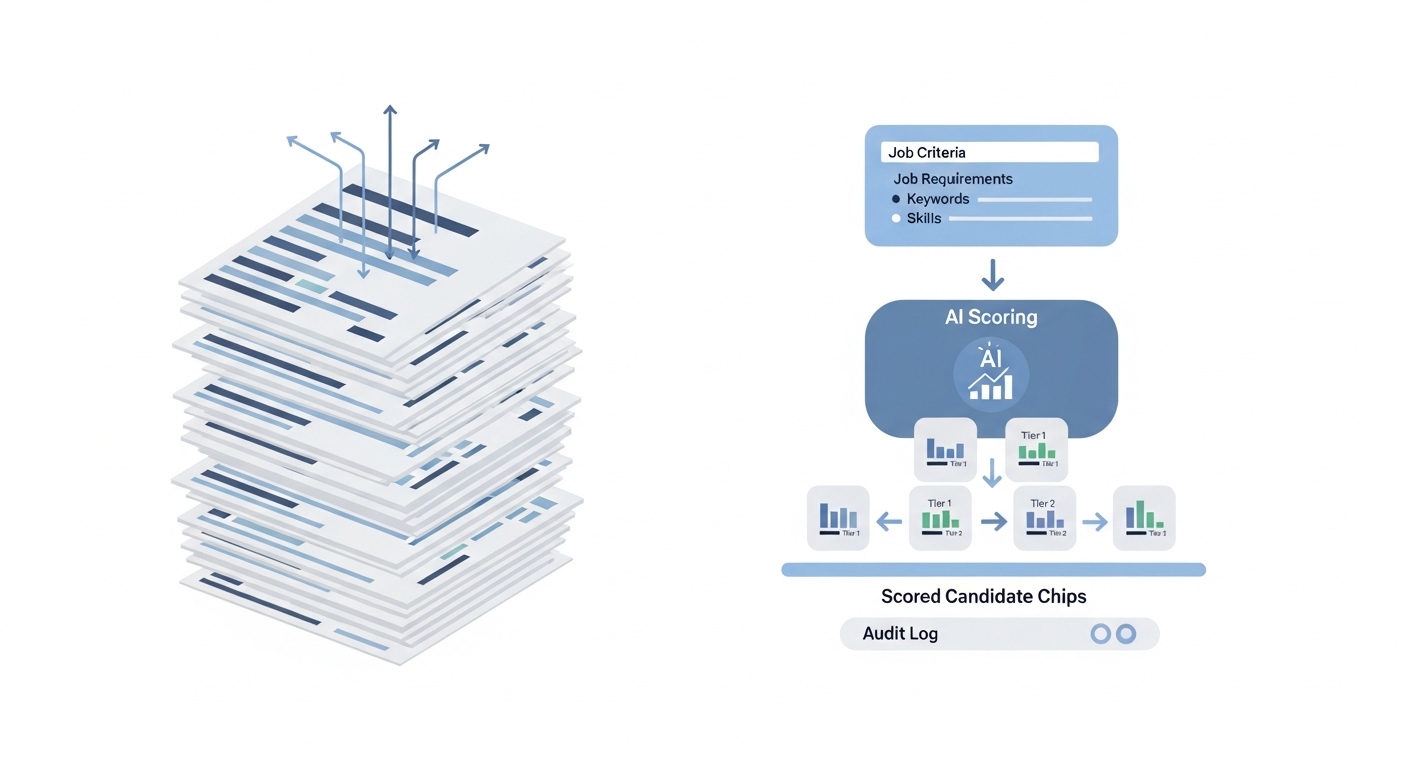
Artificial intelligence resume screening means software reads submitted CVs before a recruiter does, scores or ranks each one against the job criteria, and returns a shorter list for human review. It replaces the first manual sort pass, not the hiring decision itself.
In practice
- A high-volume operator receives 400 applications per week. An LLM prompt scores each CV on four criteria, returns a tier, and the recruiter reviews only the top tier, cutting first-pass time from twelve hours to ninety minutes.
- A sourcer using an AI screening plugin in an ATS notices that candidates from three specific universities cluster in the top tier every run. That pattern is worth auditing before it becomes policy.
- In a debrief, a TA manager might say the model filtered out a strong candidate because the CV used different wording for the same skill. Synonyms and job title variations are a recurring calibration problem.
Quick read, then how hiring teams use it
This is for recruiters, sourcers, TA, and HR partners who need the same vocabulary in debriefs, vendor calls, and policy reviews. Skim the first section when you need a fast shared picture. Use the second when you are deciding how screening fits your ATS, your legal exposure, and your review workflow.
Plain-language summary
- What it means for you: Before a recruiter opens a single CV, software reads all of them and flags which ones match the job criteria most closely. You review the flag, not the pile.
- How you would use it: You set the criteria (must-have skills, minimum tenure, role type), the model scores each CV, and you read the top band, adjusting the threshold if it is too tight or too loose.
- How to get started: Run the model on a set of CVs where you already know who got through and who did not. Compare its ranking to your past decisions. Fix the gap before it touches live candidates.
- When it is a good time: After you have at least thirty applications per cycle, stable criteria that do not change week to week, and a completed legal review of the tool you plan to use.
When you are running live reqs and tools
- What it means for you: AI screening changes candidate state. It produces scores, tiers, or flags that follow the record into your ATS and influence downstream decisions. That is different from a recruiter making a personal note.
- How to use it: Pair screening output with a human-in-the-loop gate. The model ranks; a recruiter reviews the top cut before any candidate advances or receives a rejection. Log the model version and criteria used for each run.
- How to get started: Run an adverse impact check on your first batch. Compare pass rates across gender, age, and ethnicity proxies. If a group passes at less than four-fifths the rate of the highest-passing group, pause and investigate before continuing.
- What to watch for: Vendor-silent model updates that change scoring without notice, proxy variables such as university or location that correlate with protected groups, and roles where criteria change so often the model is always behind.
Where we talk about this
On AI with Michal live sessions, AI resume screening comes up in both the AI in recruiting and sourcing automation tracks, specifically around how to pass criteria to a model, how to audit the output, and what legal language your policy team will ask about. If you want the full room conversation, start at Workshops and bring your current ATS name and a sample job description.
Around the web (opinions and rabbit holes)
Third-party creators move fast. Treat these as starting points, not endorsements, and double-check anything before you wire candidate data.
YouTube
- Search "AI resume screening recruiting" for current practitioner walkthroughs that show real ATS integrations and the edge cases vendor demos usually skip.
- Search "automated resume screening bias" for sessions covering group-level pass-rate testing and what recruiters found when they audited their own models.
- r/recruiting threads on AI screening surface real recruiter frustrations: missed candidates, synonym problems, and vendor claims that did not match production.
- Search "AI resume screening" in r/humanresources for HR leader perspectives on policy and legal exposure before rollout.
Quora
- How do companies use AI to screen resumes? collects practitioner answers ranging from tactical to skeptical (quality varies, so read critically).
AI screening versus manual review
| Stage | Manual | AI-assisted |
|---|---|---|
| First-pass time | High for large volumes | Substantially reduced |
| Consistency | Varies by reviewer | Consistent within a run |
| Bias risk | Implicit human bias | Encoded pattern bias |
| Auditability | Relies on notes | Requires structured logging |
Related on this site
- Glossary: Resume parsing, Adverse impact, AI bias audit, Human-in-the-loop (HITL), Scorecard, Talent acquisition (TA)
- Blog: Boolean search vs AI sourcing
- Guides: Sourcers
- Live cohort: Workshops
- Course: Starting with AI: the foundations in recruiting
- Membership: Become a member