GitHub talent sourcing
A technical sourcing method that uses GitHub's public activity signals - repository contributions, language usage, star counts, and commit history - to identify and prioritize software engineers for outreach, often combined with Boolean search or AI-assisted filtering.
Michal Juhas · Last reviewed May 4, 2026
What is GitHub talent sourcing?
GitHub talent sourcing is a technical recruiting method that uses the public activity on GitHub to identify and evaluate software engineers. Sourcers search by programming language, location, repository topic, contribution history, and project activity to find engineers whose actual work matches a technical brief, rather than relying on self-reported skills on a resume or LinkedIn profile.
The method has become standard for technical roles because it surfaces evidence of skill rather than claims. An engineer who has contributed to an open-source database project or maintains an active library in a specialized language is showing what they build, not just what they say they can build.
In practice
- A technical sourcer searching
language:Go location:Amsterdam followers:>50on GitHub is building a long-list of active Go developers in a specific city to review before any outreach. - When an engineering hiring manager says "I want someone who has worked on distributed systems in production," a GitHub search for contributors to well-known distributed systems projects gives a shortlist that a keyword search on resumes would not produce.
- The failure mode is treating a sparse GitHub profile as evidence of weakness rather than evidence of work done primarily in private repos, which is the default for most senior engineers at established companies.
Quick read, then how hiring teams use it
This is for technical sourcers, full-cycle recruiters handling engineering roles, and TA leads building out technical hiring workflows. Skim the first section for the vocabulary. Use the second section when you are running live technical reqs.
Plain-language summary
- What it means for you: GitHub is a public portfolio of what engineers actually build. Sourcing there gives you evidence of skill before you schedule a conversation.
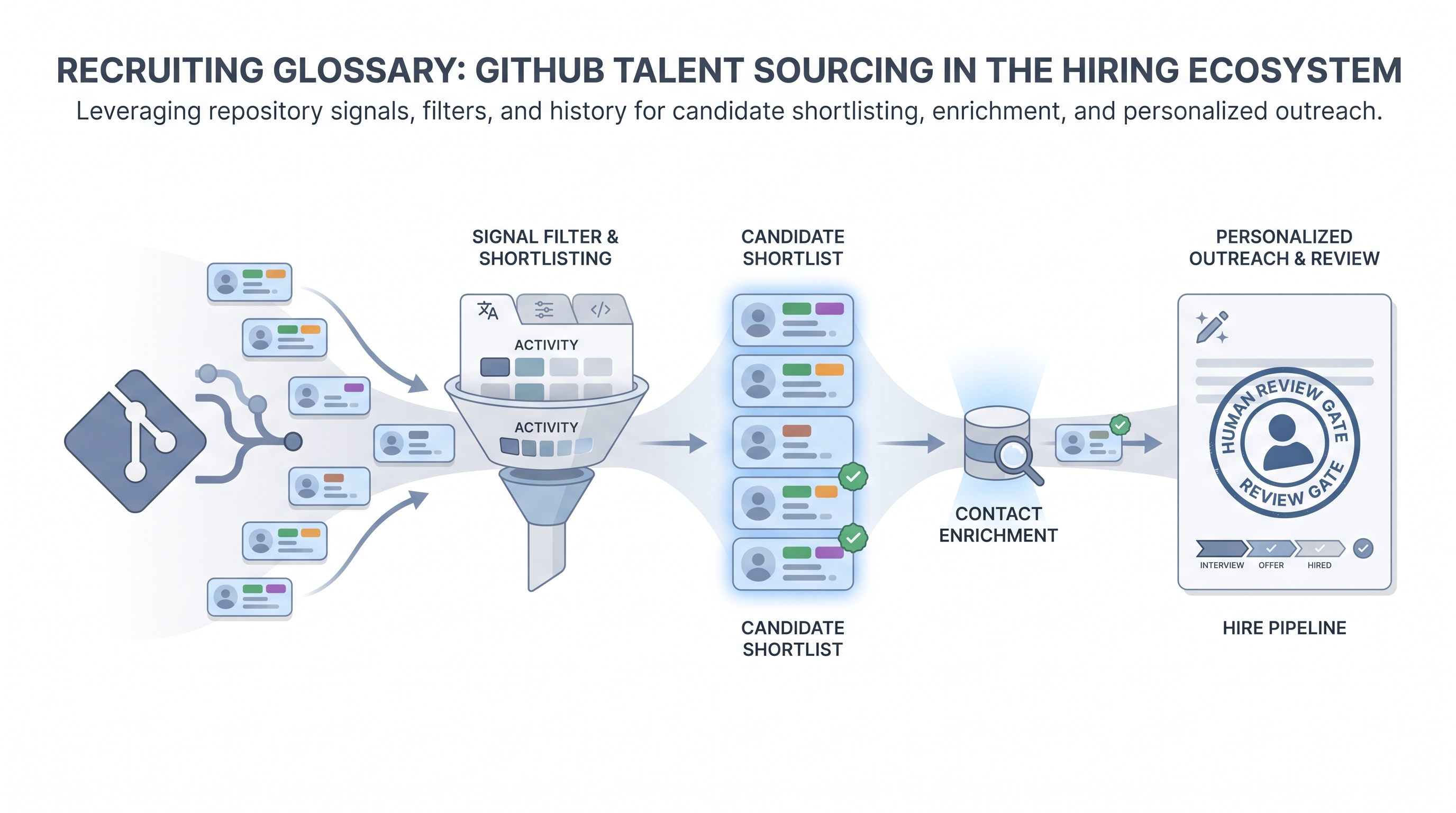
- How you would use it: Search by language, location, and activity level to build a long-list. Review profiles manually or with an AI sourcing tool. Enrich with contact data. Personalize outreach based on something specific in their public work.
- How to get started: Open github.com/search, set language to your target stack, location to your target geography, and sort by recent activity. Review the first 20 profiles and compare them to your last hire in that role.
- When it is a good time: For niche technical roles where keyword searches on job boards produce too many irrelevant results, and for senior roles where the right candidate is not actively applying anywhere.
When you are running live reqs and tools
- What it means for you: GitHub sourcing gives you a long-list, not a shortlist. Human review before outreach is not optional if you want response rates above single digits.
- When it is a good time: For roles where the technical brief is specific enough to distinguish strong signal from noise in GitHub activity, and where you have time to review profiles before automating outreach.
- How to use it: Combine GitHub search with AI sourcing tools for scale, add contact enrichment sourcing for verified contact data, and route reviewed profiles into the ATS via workflow automation. Keep the human review step before any message sends.
- How to get started: Map the technical signals that predicted success in your last five hires for this role type. Build a GitHub search that captures those signals. Run a parallel test against your current sourcing method for four weeks.
- What to watch for: Systematic underrepresentation of engineers from underrepresented groups and geographies in public open-source activity. Senior engineers with sparse public profiles who do their best work in private repos. Duplicate outreach from multiple team members targeting the same GitHub users.
Where we talk about this
On AI with Michal live sessions GitHub sourcing comes up in the sourcing automation track when we cover technical talent sourcing and Boolean search extensions. The AI in recruiting track covers how to connect GitHub signals with AI-assisted profile ranking and how to personalize outreach at scale without losing the specificity that makes technical outreach work. Bring specific role types and technical stacks to Workshops for a room-tested discussion on which signals carry predictive weight in your market.
Around the web (opinions and rabbit holes)
Technical sourcing communities move fast on GitHub search techniques. Treat these as starting points and cross-reference with recent posts from sourcers in your specific engineering community.
YouTube
- How to source engineers on GitHub covers search syntax, API basics, and outreach personalization walkthroughs from technical sourcers.
- GitHub search for recruiters includes step-by-step tutorials on GitHub advanced search filters used in real technical sourcing workflows.
- Technical sourcing strategies 2025 covers GitHub alongside other developer community sourcing channels for a broader workflow picture.
- Sourcing engineers on GitHub in r/recruiting collects practitioner approaches to GitHub search with honest notes on response rates and limitations.
- Technical recruiting tips GitHub in r/recruiting surfaces advice from sourcers who specialize in engineering roles.
- Bias in technical sourcing in r/recruiting discusses the demographic representation problem in open-source activity with practical mitigation approaches.
Quora
- How do recruiters use GitHub to find candidates? collects practitioner answers on search approaches and outreach personalization tactics.
GitHub signals by use case
| Signal | Best for | Limitation |
|---|---|---|
| Language distribution | Stack match | Private repo work not reflected |
| Original repo creation | Self-direction and ownership | Tutorial repos inflate the count |
| Contributions to high-star projects | Production code quality | Requires manual review to assess depth |
| Recent commit activity | Active engagement | Seasonal gaps (vacation, job change) |
| README quality | Communication skills | Many engineers deprioritize documentation |
Related on this site
- Glossary: Technical talent sourcing, AI sourcing tools, Boolean search, Contact enrichment sourcing, Outbound talent sourcing, Multi-channel talent sourcing, Workflow automation, Talent sourcing software
- Blog: AI sourcing tools for recruiters
- Guides: Sourcers
- Workshops: AI in recruiting
- Membership: Become a member
- Courses: Starting with AI: the foundations in recruiting
Frequently asked questions
What is GitHub talent sourcing and why do technical sourcers use it?
How do I search GitHub for candidates?
language:Rust location:Berlin stars:>50, let you narrow by specific technical criteria efficiently.