Stack Overflow talent sourcing
Using public Stack Overflow profile data - reputation scores, top tags, and accepted answers - to identify and approach technical candidates, typically combined with contact enrichment since the platform's dedicated Jobs board closed in 2022.
Michal Juhas · Last reviewed May 5, 2026
What is Stack Overflow talent sourcing?
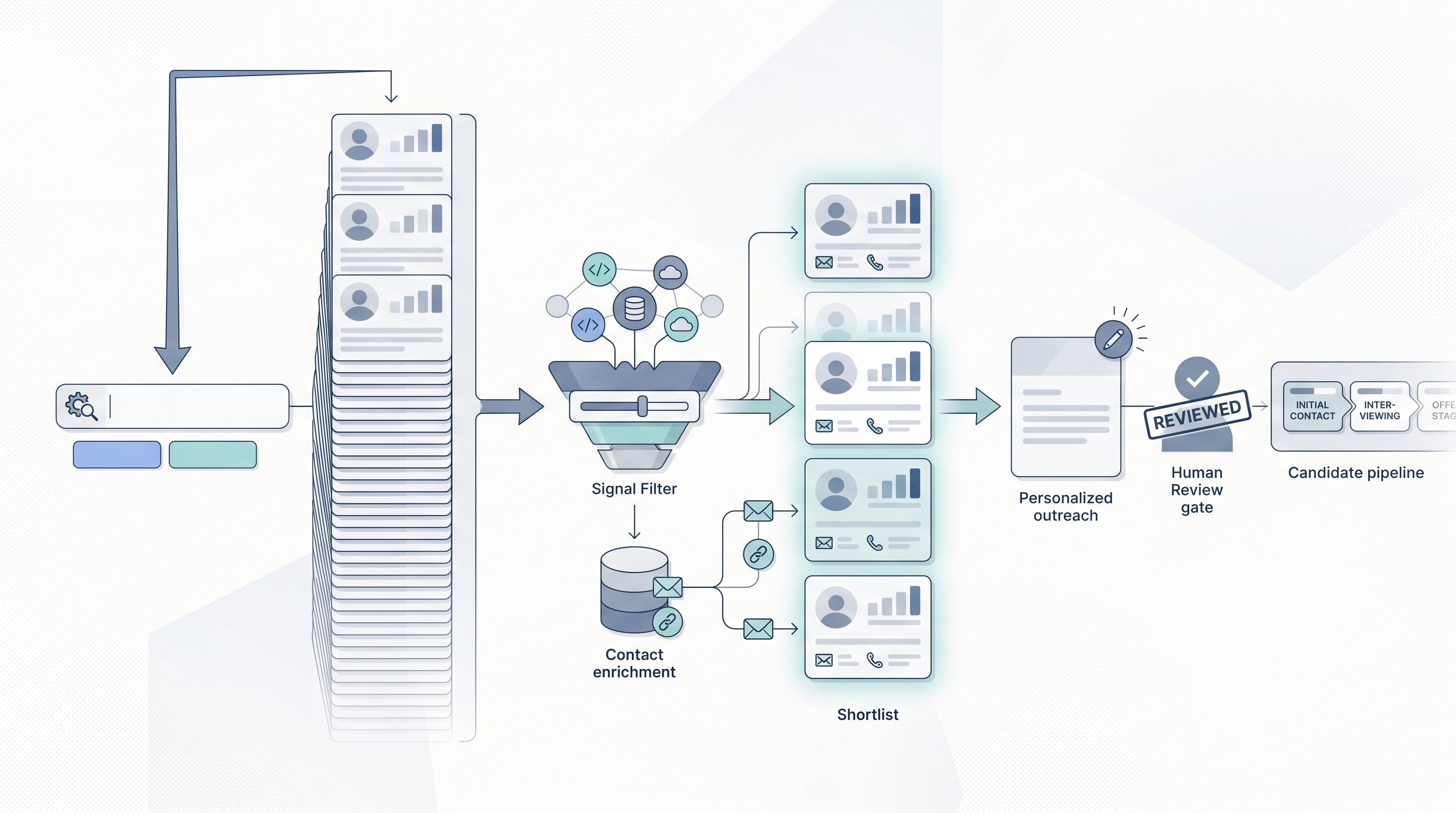
Stack Overflow talent sourcing means using the public contribution activity on Stack Overflow - reputation scores, top tags, accepted answers, and About sections - to find and approach technical candidates. Because the platform shut its Jobs board in 2022, there is no built-in messaging tool, so sourcers combine X-ray search and enrichment to turn profile signals into contactable leads.
In practice
- A sourcer building a Python data engineering shortlist might run
site:stackoverflow.com/users intitle:"python" "apache spark"in Google, then cross-reference the returned profiles against a contact enrichment database to find work emails or LinkedIn URLs. - In a TA debrief a hiring manager might say "find someone who can explain distributed systems clearly, not just build them" - that is exactly the kind of signal a Stack Overflow reputation score and accepted-answer history surfaces.
- At a 400-person product company one ops engineer described their rule: "if the profile has at least 5,000 reputation in the right tags and a personal site URL in the About section, it goes to enrichment." Simple, consistent, and fast to apply across the sourcing team.
Quick read, then how hiring teams use it
This is for recruiters, sourcers, TA, and HR partners who need the same vocabulary in debriefs, vendor calls, and policy reviews. Skim the first section when you need a fast shared picture. Use the second when you are deciding how it shows up in your sourcing workflow, enrichment stack, or outreach sequence.
Plain-language summary
- What it means for you: Stack Overflow profiles are public records of how well a developer explains and solves problems. High reputation in specific technology tags is a community-verified signal that hiring managers often trust more than a resume line claiming the same skill.
- How you would use it: Search for profiles matching the role's technical stack, check the top tags and reputation range, and then pass the shortlist through an enrichment tool to find a contactable email or LinkedIn URL.
- How to get started: Pick three to five technology tags for the role. Build a Google X-ray search using
site:stackoverflow.com/users intitle:and your top tag. Pull ten profiles and calibrate what reputation ranges and tag patterns match the role before you scale. - When it is a good time: When the role requires deep technical expertise that is hard to screen for in a 30-minute call, and when GitHub activity alone does not capture the conceptual depth or teaching ability the team needs.
When you are running live reqs and tools
- What it means for you: Stack Overflow data layers on top of your existing sourcing workflow. It does not replace LinkedIn or GitHub outreach but adds a credibility signal that improves shortlist quality for senior technical and specialist roles.
- When it is a good time: On senior software engineering, data science, and developer relations roles where community engagement and the ability to explain problems in writing are core to the job. Lower priority for roles where execution speed matters more than technical depth or communication.
- How to use it: Combine with contact enrichment tools that cross-reference Stack Overflow usernames with work email addresses or LinkedIn profiles. Log the source URL in your ATS or CRM for GDPR documentation. Keep outreach personal - reference a specific answer or tag area the candidate has contributed to.
- How to get started: Check whether your current enrichment provider indexes Stack Overflow profiles. If not, start with manual X-ray searches to build a test list of 20 profiles, enrich them, and measure response rates before committing to a tool subscription. Read technical talent sourcing for the broader multi-platform pattern.
- What to watch for: Low response rates from inactive profiles, GDPR notification obligations at first outreach, and selection bias toward candidates who post publicly versus those who do equivalent work in private or proprietary environments.
Where we talk about this
On AI with Michal live sessions, Stack Overflow sourcing comes up in sourcing automation blocks when we build multi-channel pipelines that pull signals from public developer platforms alongside LinkedIn. If you want the full room conversation about which signals sourcers actually trust and how to wire them into an ATS without violating your DPA, start at Workshops.
Around the web (opinions and rabbit holes)
Third-party creators move fast. Treat these as starting points, not endorsements, and do not copy any script that moves candidate data between platforms without reviewing its data handling first.
YouTube
- Search "stack overflow sourcing recruiter" or "x-ray search developers stackoverflow" on YouTube to find technical sourcing practitioners walking through Google X-ray workflows for developer platforms - a well-covered topic in the technical recruiting community.
- Sourcing From Developer Platforms - Why GitHub and Stack Overflow turns up several practitioner walkthroughs of platform-signal sourcing alongside Boolean search techniques.
- r/recruiting has recurring threads on technical sourcing channels - search "stack overflow" within the subreddit to find candid recruiter discussions about what response rates actually look like.
- r/cscareerquestions gives the candidate side: how developers feel about recruiter outreach that references their public contributions, which is useful for calibrating your outreach tone.
Stack Overflow Blog
- stackoverflow.blog publishes the annual Developer Survey (the most-cited data on which technologies developers use and how they feel about job searching), which is the best public calibration tool before you build a sourcing strategy around specific tags.
Stack Overflow versus GitHub sourcing signals
| Dimension | Stack Overflow | GitHub |
|---|---|---|
| Primary signal | Explains and teaches concepts | Ships code and collaborates |
| Best role fit | Senior IC, tech leads, DevRel | Most software engineering roles |
| Profile completeness | Variable - many anonymous accounts | Often includes username and bio |
| Contact path | About section URL or enrichment | Profile email or enrichment |
| Response rate risk | High - frequent recruiter inbound | Moderate |
| GDPR consideration | Same as any public data source | Same as any public data source |
Related on this site
- Glossary: Technical talent sourcing, GitHub talent sourcing, Boolean search, Contact enrichment for sourcing, Candidate data enrichment, Human-in-the-loop, Outbound talent sourcing
- Blog: AI sourcing tools for recruiters, Boolean search vs AI sourcing
- Guides: Sourcers
- Live cohort: Workshops - sourcing automation track
- Membership: Become a member
Frequently asked questions
What is Stack Overflow talent sourcing?
How do sourcers search for candidates on Stack Overflow?
site:stackoverflow.com/users intitle:"python" "machine learning" narrows indexed profile pages by tag headings. Combine with location mentions or company names in the About field for further targeting. Some enrichment databases pre-index Stack Overflow usernames alongside LinkedIn URLs, letting you skip the manual search step. The Stack Overflow API lets you query top users by tag programmatically, though it returns display names rather than contact details, so enrichment is still required. Calibrate your reputation floor for the role before scaling: 1K signals a serious user, 5K-plus suggests sustained expertise in the tags that matter for your open role.