Hiring platforms
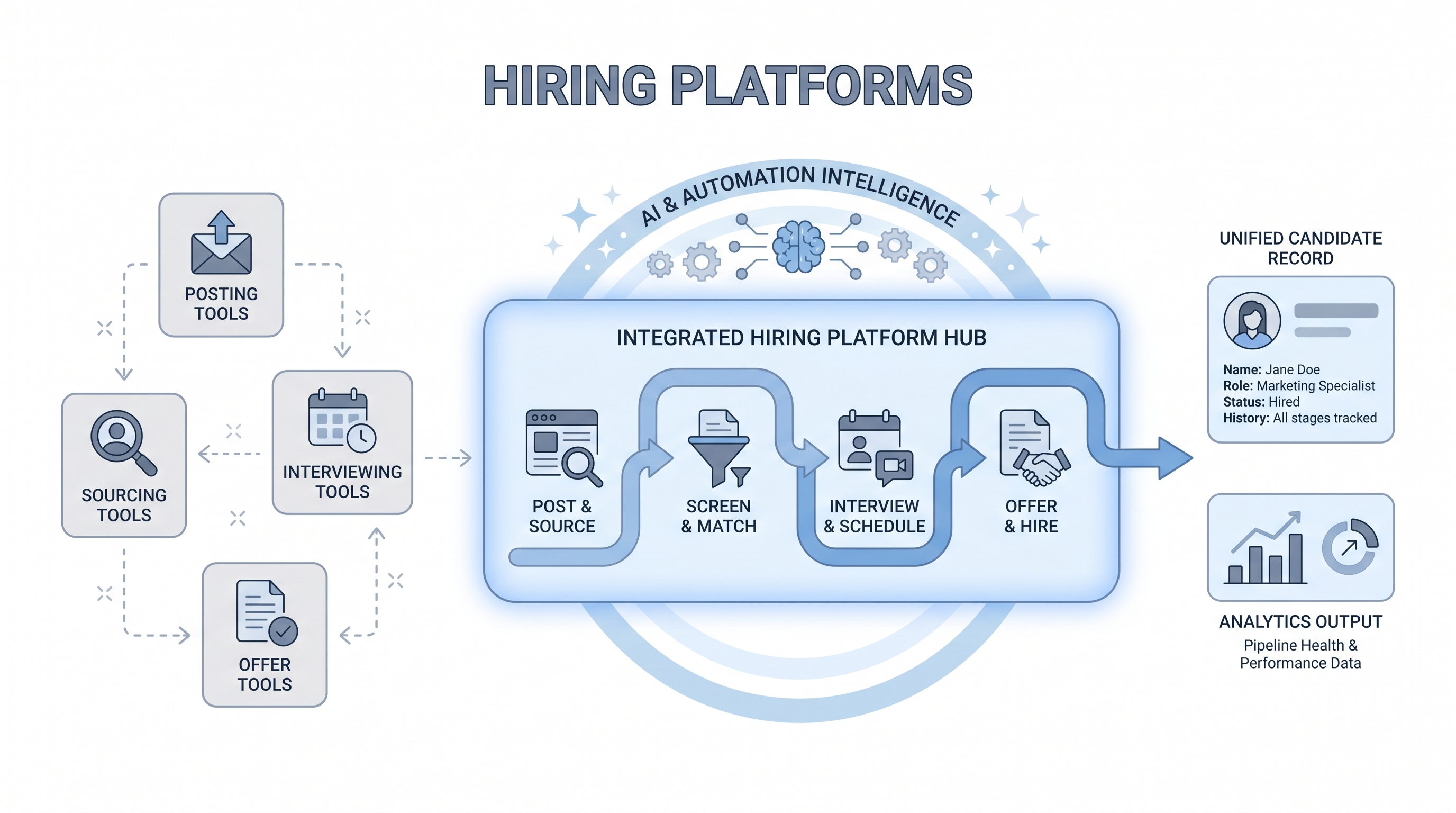
Web-based or cloud software that centralises job posting, application intake, candidate evaluation, interview coordination, and offer management under one contract or tightly integrated suite, giving TA teams a single system of record across the hiring funnel.
Michal Juhas · Last reviewed May 4, 2026
What are hiring platforms?
Hiring platforms are web-based or cloud software products that cover at least two consecutive stages of the recruitment funnel inside one system. The core offering is usually an applicant tracking layer combined with candidate coordination tools, but modern platforms extend into sourcing, resume parsing, interview scheduling, offer management, and built-in AI features. The word "platform" signals more than a single tool: it implies a shared data model where a candidate record moves through the process without manual re-entry between systems.
In practice
- A TA ops lead presenting a stack audit might say "we have a platform but we're still using three other tools around it," meaning the platform doesn't cover sourcing or analytics the way it was sold.
- A recruiter who can't see a candidate's application history from inside the interview scheduler is experiencing the data silo that platforms promise to close.
- A TA leader pulling quarterly reporting from a platform may find that "time to fill" in the platform dashboard does not match the number pulled from the ATS API, because two modules use different event definitions.
Quick read, then how hiring teams use it
This is for recruiters, TA leads, and HRBPs making stack decisions, evaluating platform vendors, or navigating a migration. Skim the first section for the core picture. Use the second when you are running a live evaluation or dealing with a live platform's limits.
Plain-language summary
- What it means for you: A hiring platform is a product that handles more than one step of your recruiting process under one login, one contract, and one candidate record.
- How you would use it: Consolidate the stages that break most often when tools don't talk to each other. For most teams, that's the handoff between sourcing and your ATS, or between screening and interview scheduling.
- How to get started: List every tool your team uses today, which stage it covers, and how candidate data moves between each. Any gap in that map is where a platform would either close the loop or where a platform's promises are likely to fall short.
- When it is a good time: Before signing a new vendor contract, before a headcount jump that will expose integration limits, or after a quarter where a hiring bottleneck traced back to a broken handoff between two tools.
When you are running live reqs and tools
- What it means for you: Every stage a platform touches is a data processing decision with legal weight, not just a feature checklist on a slide.
- When it is a good time: Before you activate any AI feature that affects who advances in the funnel. Platform AI is typically on by default once enabled; confirm what it does and log it before it processes real candidates.
- How to use it: Map which platform modules own which stage. Confirm which fields are authoritative in the platform versus in a connected HRIS or background check tool. Log model versions and prompt configurations for any AI-generated score or suggestion that influences who progresses. Add a human review gate before outbound messages and before any reject decision.
- How to get started: Pull a one-line data flow diagram per stage: input, platform action, output destination, and who reviews it. Most teams find one or two stages where the platform acts without a logged reviewer.
- What to watch for: Vendors that fold AI features into a platform tier mid-contract without re-opening the data processing agreement. Integration changes that silently drop or overwrite candidate fields. Scoring or ranking outputs that influence shortlists but are never re-calibrated after initial setup.
Where we talk about this
On AI with Michal live sessions, hiring platforms come up in both tracks. AI in recruiting workshops cover platform evaluation criteria, how to stress-test AI features before turning them on at volume, and where human review gates belong in a platform-managed funnel. Sourcing automation workshops dig into the ATS layer: field mapping, webhook reliability, and what breaks when a platform vendor changes an API version. Bring your current platform list and your biggest friction point to Workshops.
Around the web (opinions and rabbit holes)
Third-party creators cover hiring platforms at volume. Treat these as starting points, not endorsements, and verify compliance postures and feature sets directly with vendors before any purchase.
YouTube
- Hiring platform comparison and demo surfaces recent side-by-side walkthroughs of popular platforms, with real workflow demos rather than slide decks.
- How to migrate to a new ATS or hiring platform covers what practitioners discovered about data portability when moving from one platform to another.
- AI features in modern hiring platforms shows how AI sourcing, screening, and scheduling are being shipped inside platforms rather than as standalone add-ons.
- What hiring platform does your team use? in r/recruiting collects candid comparisons from in-house TA teams across company sizes.
- Platform migration experience in r/recruiting captures honest accounts of what went wrong and what teams wish they had negotiated before switching.
- AI in hiring platforms in r/recruiting separates real daily use from demo-mode claims.
Quora
- What are the best hiring platforms for recruiting? collects practitioner and vendor perspectives across company sizes (quality varies; read critically).
Hiring platforms vs related terms
| Term | What it covers | Where it stops |
|---|---|---|
| Hiring platform | Multi-stage pipeline, usually ATS plus at least one adjacent module | May not cover sourcing, analytics, or onboarding |
| Applicant tracking software | Application intake, stage tracking, recruiter coordination | Typically stops before sourcing or scheduling |
| Hiring tools | Any software used in the hiring process, including point solutions | No shared data model across stages by default |
| AI recruitment platform | Platform with embedded AI sourcing, screening, or copilot features | Narrower: implies AI-first architecture |
Related on this site
- Glossary: Applicant tracking software, Hiring tools, AI recruitment platform, AI recruiting tools, Workflow automation, Resume parsing, Semantic search, AI bias audit
- Blog: AI sourcing tools for recruiters
- Guides: Sourcers
- Workshops: AI in recruiting
- Membership: Become a member
- Courses: Starting with AI: the foundations in recruiting